It is April 1st. A day for pranks, tricks, and manufactured surprises.
Here is the real joke hiding in most B2B boardrooms: leadership teams spend enormous energy trying to win new customers while quietly ignoring the behavioral science that keeps existing customers loyal, sticky, and growth-ready — even when a competitor is offering something objectively better.
The phenomenon is called the endowment effect. And if you are running a company that sells to other businesses, it is one of the most important forces shaping your renewal rates, expansion revenue, and pricing power — whether you are using it deliberately or not (Kahneman, Knetsch, & Thaler, 1991).
What the Endowment Effect Actually Means in B2B
The endowment effect is a well-documented cognitive bias: people consistently value what they already own more than they would pay to acquire the same thing as a new purchase (Kahneman et al., 1991). In classic research, people demand significantly more to give up a coffee mug they have been handed than they would spend to buy one.
In B2B, the “mug” is an entire operating system — configured workflows, named dashboards, trained administrators, integrated data pipelines, and the internal credibility of the champion who said “we should adopt this.”
Leaving your platform does not feel like switching vendors. It feels like deleting part of the company’s memory.
That distinction matters strategically. It explains why customers stay even when ROI softens. It explains why competitive demos rarely produce the displacement they promise. And it explains why companies that understand this dynamic grow faster and more profitably than those that don’t.
The Bias Stack Underneath Your Renewal Rate
The endowment effect does not work alone. It is reinforced by a stack of related cognitive mechanisms:
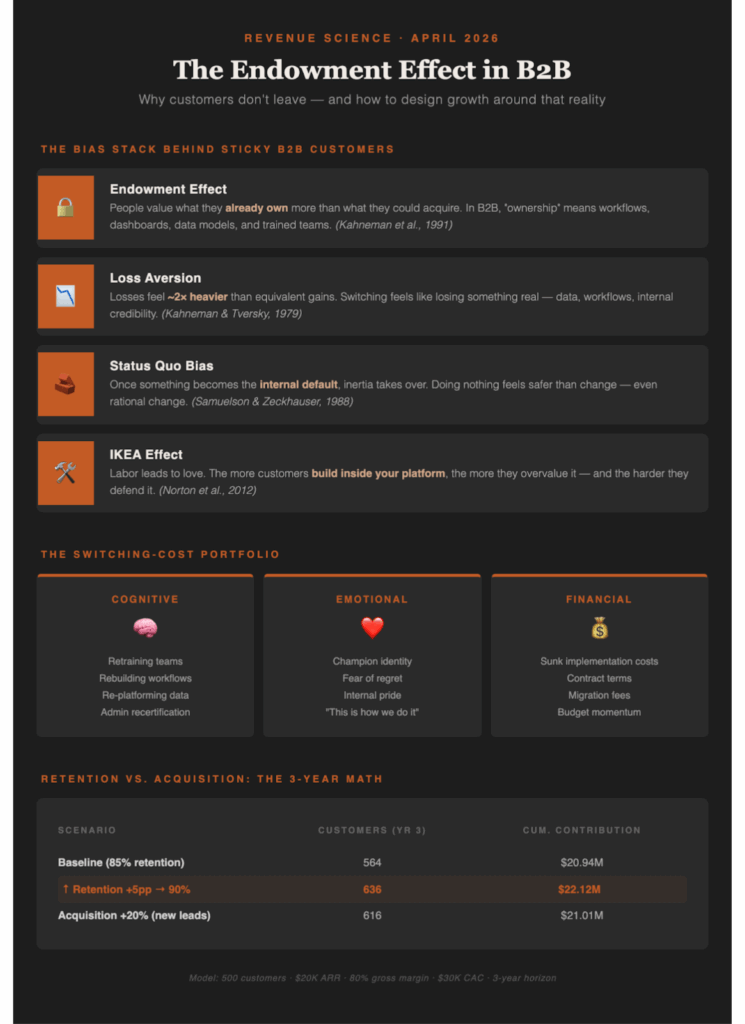
Loss aversion means that losses feel approximately twice as painful as equivalent gains feel good (Kahneman & Tversky, 1979). When a customer contemplates switching, they are not running a rational ROI comparison — they are weighing what they stand to lose. Disruption, retraining, data migration, re-platforming politics. Those feel like losses, not costs.
Status quo bias means that once something becomes the internal default, doing nothing is always the path of least resistance (Samuelson & Zeckhauser, 1988). If your platform is how work gets done today, every alternative has to overcome the psychological weight of the status quo just to get a fair evaluation.
The IKEA effect means that people overvalue what they helped build — especially when the work reached successful completion (Norton, Mochon, & Ariely, 2012). The customer who built your custom dashboards, configured your automation rules, and trained their team on your system now has an emotional relationship with the output of that labor.
Together, these biases mean the bar for displacement is much higher than most competitive sales reps assume — and the opportunity to build genuine, compounding retention is much larger than most CS teams are pursuing.
Three Types of Switching Costs — and Why Most Companies Miss Two of Them
Most executives think about switching costs in purely financial terms: contract length, migration fees, exit penalties. That is the smallest lever.
A robust typology identifies three distinct types of switching costs: procedural (time and effort), financial (quantifiable loss), and relational (identity and bonds) (Burnham, Frels, & Mahajan, 2003). In B2B go-to-market, those map cleanly to cognitive, emotional, and financial switching costs.
The companies that grow systemically invest in all three — not as manipulation, but as product design:
- Cognitive lock-in builds when customers complete meaningful configuration work: integrations, automations, certified admin programs. Every artifact they build raises the cognitive cost of rebuilding it elsewhere.
- Emotional lock-in builds when the champion’s internal reputation is tied to the success of the platform. Shared wins, executive readouts, and published internal success narratives make leaving feel like disowning a decision you publicly championed.
- Financial lock-in builds when multi-year pricing rewards tenure and when customers have invested meaningful professional services hours they cannot recover.
The critical caveat: if switching costs are high but value is low, you have built a trap — not a business. Traps generate backlash, legal risk, and eventually disruptive churn. The goal is to design switching costs that reflect genuine, compounding value.
The First 90 Days Are Everything
If you want a practical definition of the endowment effect in B2B, here it is: by day 90, the customer should feel like leaving means losing something they built.
That is not achieved by a series of onboarding check-ins. It is achieved by manufacturing psychological ownership — through control, meaningful self-investment, and completed work (Rogers, 2020).
The IKEA effect research is blunt: the love-of-labor effect only activates when the task reaches successful completion (Norton et al., 2012). Incomplete implementations produce weak attachment. Which means your onboarding must be designed around completion milestones, not activity counts.
This is the playbook ServiceNow has executed at enterprise scale for years. The company disclosed renewal rates of approximately 98% — a level that reflects not just product quality but deep procedural investment: platform configuration, integrations, and the migration cost of leaving behind years of custom-built workflow architecture (ServiceNow, 2026). High cognitive switching costs, compounding over time.
HubSpot has weaponized the same logic in the mid-market through freemium: reduce the perceived loss of trying, let customers adopt before paying, and let early value become “our workflow” before the pricing conversation begins (HubSpot, 2025). Once the tool becomes the internal default, competitive displacement requires more than a better feature set.
Zoom’s early enterprise expansion followed the same pattern: large customers started with a single deployment in one team or location, and the platform rolled out broadly as it became the local status quo (Zoom Video Communications, 2019). Switching later would have meant disruption, retraining, and loss — not just a vendor change.
Why Retention Is a Capital Allocation Strategy
Boards love new logos because the graph moves immediately. Retention compounds quietly — and that is exactly why it is undervalued.
Classic work in customer economics documented how sharply profits can rise as defection rates fall — in some observed cases, a 5-percentage-point improvement in retention produced profit increases far exceeding what equivalent acquisition investment would generate (Reichheld & Sasser, 1990). A widely cited Bain summary reinforces this logic: even modest retention improvements can substantially boost profits in recurring-revenue businesses (Bain & Company, 2006).
The simple model tells the story clearly: in a recurring-revenue business with $10M ARR and 15% churn, reducing churn by 5 percentage points delivers more customers and more cumulative gross profit after three years than a 20% increase in new customer acquisition — at no additional CAC.
Retention is not a Customer Success metric. It is a capital allocation strategy.
The executives who grow companies systemically are not just acquiring customers. They are designing the product, the onboarding, the CS motion, and the pricing architecture around a single principle: by the time renewal arrives, leaving should feel like a loss — not just a decision.
That is not manipulation. That is how human brains actually work. Your job is to build for the real customer, not the rational one.
About Rich Smith: Rich Smith is an executive advisor, behavioral marketing strategist, investor, CMO, and host of the Revenue Science Podcast, known for helping leaders understand not only what growth strategies work—but why. With more than thirty years of experience leading growth across financial services, healthcare, technology, and consumer brands, Rich has guided companies through crises, rebuilt brands from the ground up, and helped position organizations for nine-figure exits. Connect at RichMSmith.com, on LinkedIn, and on The Revenue Science Podcast.
References
Bain & Company. (2006). Retaining customers is the real challenge.
Burnham, T. A., Frels, J. K., & Mahajan, V. (2003). Consumer switching costs: A typology, antecedents, and consequences. Journal of the Academy of Marketing Science, 31, 109–126. https://doi.org/10.1177/0092070302250897
HubSpot. (2025). Annual Report on Form 10-K (fiscal year ended December 31, 2024).
Kahneman, D., Knetsch, J. L., & Thaler, R. H. (1991). Anomalies: The endowment effect, loss aversion, and status quo bias. Journal of Economic Perspectives, 5(1), 193–206. https://doi.org/10.1257/jep.5.1.193
Kahneman, D., & Tversky, A. (1979). Prospect theory: An analysis of decision under risk. Econometrica, 47(2), 263–291.
Norton, M. I., Mochon, D., & Ariely, D. (2012). The IKEA effect: When labor leads to love. Journal of Consumer Psychology, 22(3), 453–460. https://doi.org/10.1016/j.jcps.2011.08.002
Reichheld, F. F., & Sasser, W. E., Jr. (1990). Zero defections: Quality comes to services. Harvard Business Review, 68(5), 105–111.
Rogers, P. (2020). Application of psychological ownership theory to access-based consumption and the circular economy. In Proceedings of the Inaugural Conference of the International Society 4 Circular Economy (IS4CE2020).
Samuelson, W., & Zeckhauser, R. (1988). Status quo bias in decision making. Journal of Risk and Uncertainty, 1, 7–59. https://doi.org/10.1007/BF00055564
ServiceNow. (2026). Annual Report on Form 10-K (fiscal year ended December 31, 2025).
Zoom Video Communications. (2019). Form S-1 Registration Statement.