
It is early April 2026. Q1 is closed. Q2 targets are freshly posted. And somewhere on your team, a smart rep is scratching their head wondering why a qualified buyer who seemed genuinely excited three weeks ago has suddenly gone quiet.
The buyer is not uninterested. They are exhausted.
Not physically—cognitively. And that distinction is everything.
The hidden tax on every B2B deal
Decision fatigue is the predictable deterioration in decision quality that follows repeated rounds of choosing. Vohs and colleagues (2006) describe a “hidden cost to choosing” where the act of making decisions depletes the psychological resources required to make the next one. The more choices people make, the more likely they are to simplify, defer, or default to inaction.
Now consider what modern B2B buying actually demands. Gartner’s research on the B2B buying journey describes a process where buyers must loop through multiple overlapping tasks—problem identification, solution exploration, requirements building, supplier selection, validation, and consensus creation—often simultaneously, not sequentially (Gartner, n.d.). Add six to ten stakeholders, each conducting independent research and arriving at your deal with competing conclusions, and you have a system that reliably manufactures cognitive depletion.
The result is not irrational behavior. It is predictable human behavior.
What depleted buyers actually do
Research on sequential judicial decisions found that favorable outcomes dropped sharply within decision sessions before recovering after breaks—a pattern consistent with fatigued decision-makers defaulting to the safest, lowest-effort option available (Danziger, Levav, & Avnaim-Pesso, 2011). In enterprise sales, that “safe option” is brutally familiar: renew the incumbent, delay the project, or “re-scope for next quarter.”
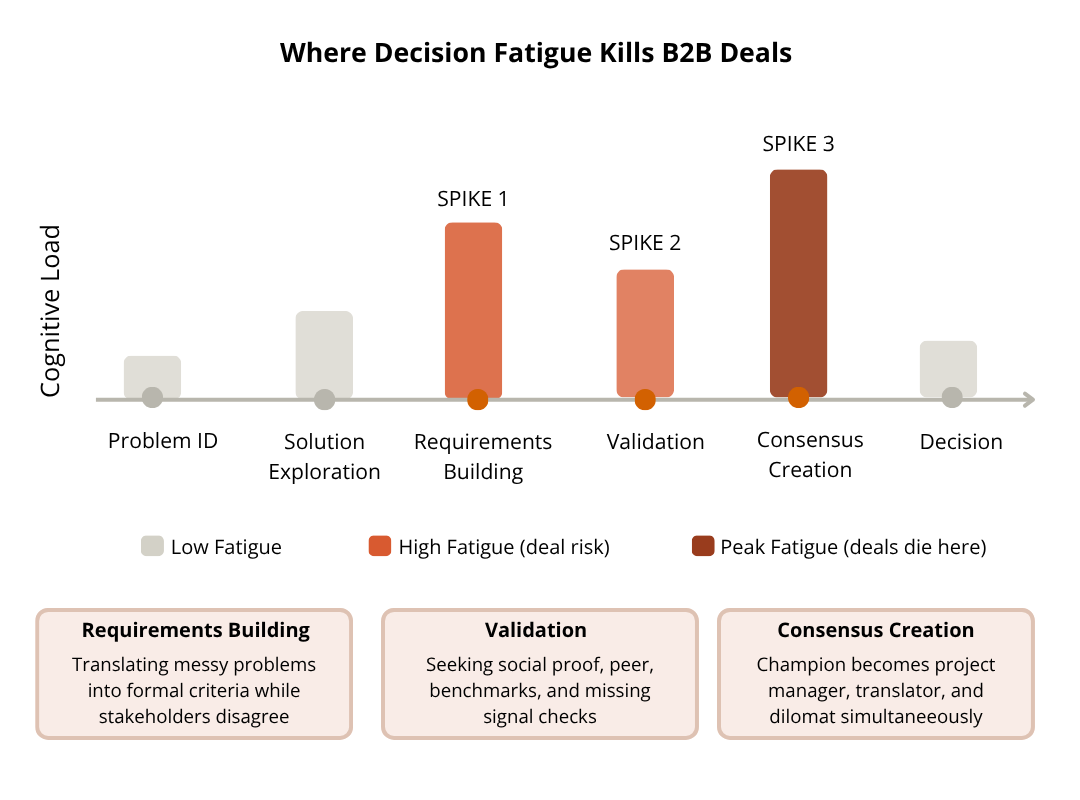
When buyers hit overload, three things happen. First, they freeze under too much choice. Iyengar and Lepper (2000) demonstrated that extensive options attract initial attention but reduce follow-through and make the process feel more difficult and frustrating. A product page with five ICPs, twelve use cases, and seven packages does not signal flexibility to a fatigued buyer. It signals risk. Second, they default to heuristics instead of analysis—shifting away from careful evaluation toward less effortful strategies, increasing avoidance and inconsistency (Frontiers in Cognition, 2025). Third, they stall on internal alignment. Your champion does not go dark because they lost interest. They go dark because they became a project manager, translator, and diplomat—on top of their actual job.
Three moments in the buyer’s journey concentrate this risk most: requirements building, validation, and consensus creation. The diagram below maps the cognitive load across each stage.
Frictionless is not friction-free
Before getting tactical, one important clarification. “Frictionless sales” is routinely misread as removing every step. It is not.
Padigar, Li, and Manjunath (2025) distinguish between “bad” friction—effort buyers exert on tasks that don’t build confidence or advance their goals—and “good” friction, which includes structured security reviews, mutual success plans, and finance-ready ROI models. Done well, those elements reduce regret, which is the real enemy of a profitable deal. Gartner explicitly warns that self-service digital purchases increase purchase regret, even though three-quarters of B2B buyers prefer a rep-free experience in early stages (Gartner, n.d.).
The executive goal is not to eliminate all friction. It is to eliminate non-value effort and standardize confidence-building effort so buyers do not have to reinvent the wheel inside their own organizations.
Four plays that convert insight into revenue
Architect fewer decisions with stronger defaults. The Behavioural Insights Team’s EAST framework is direct: defaults, simplified messages, and reduced effort drive behavior more reliably than incentives (Behavioural Insights Team, 2024). In B2B terms, this means offering one to three outcome-mapped packages instead of a feature matrix, pre-building recommended configurations by buyer segment, and using opinionated pathways—here is what companies like yours choose, and why. This simultaneously increases conversion and protects margin by reducing bespoke exceptions and discount-driven custom deals.
Replace content with decision tools. A buyer’s problem is rarely a lack of information. It is the work required to convert information into a defensible internal decision. Gartner identifies interactive tools—calculators, ROI models, selection tools—as high-value interactions that help buyers feel confident and in control (Gartner, n.d.). Practically, this means building a small set of artifacts that do the buyer’s internal labor: a one-page finance-ready business case, a mutual success plan with defined exit criteria, a security and compliance packet ready for procurement, and stakeholder briefs written in IT, finance, and operations language.
Design a hybrid experience that reduces regret. Buyers want autonomy early; they want human support when decisions become consequential. The model is digital-first clarity and evaluation, human-led validation and consensus support, and governance that prevents discounting from becoming your close strategy.
Measure effort like cost. Dixon, Freeman, and Toman (2010) published research in Harvard Business Review demonstrating that reducing customer effort builds loyalty more effectively than delight—and lowers churn. Apply this logic upstream: where do deals stall? Where do buyers request “one more meeting”? Where does legal become a black hole? These are not sales problems. They are friction points that manufacture decision fatigue.
What this looks like when it works
Danaher’s commercial execution model is instructive. In materials documenting their Pall Corporation case, Danaher reports that integrated changes to marketing, lead handling, and funnel management produced a significant increase in leads, more opportunities, and improved win rates (Danaher, as cited in Danaher DBS materials). The mechanism is not a better pitch. It is standard work that reduces both seller and buyer cognitive load—so the organization closes cleaner deals without relying on heroics.
Salesforce’s V2MOM process offers a different lesson. By codifying vision, values, methods, obstacles, and measures into a shared annual framework, Benioff built alignment at scale as the company grew from a small team to tens of thousands of employees (Salesforce, 2024). The revenue relevance is structural: misalignment creates inconsistent messaging; inconsistent messaging increases buyer effort; increased effort produces decision fatigue and no-decision outcomes. Alignment is a buyer experience strategy.
The executive bottom line
Your buyers are not failing to decide because your product is unclear. They are failing to decide because your process is expensive. Every time a buyer must re-explain the problem, re-justify the ROI, re-request the security documentation, or re-translate your deck into internal language, you are manufacturing churn before the deal even closes.
Reduce the cognitive cost of saying yes. Make it easy to justify yes. Measure effort like you measure revenue. That is how frictionless sales grows profit—not as a slogan, but as an operating system.
About Rich Smith: Rich Smith is an executive advisor, behavioral marketing strategist, investor, CMO, and host of the Revenue Science Podcast, known for helping leaders understand not only what growth strategies work—but why. With more than thirty years of experience leading growth across financial services, healthcare, technology, and consumer brands, Rich has guided companies through crises, rebuilt brands from the ground up, and helped position organizations for nine-figure exits. Connect at RichMSmith.com, on LinkedIn, and on The Revenue Science Podcast.
References
Behavioural Insights Team. (2024). EAST: Four simple ways to apply behavioural insights (revised and updated ed.). Behavioural Insights Team.
Danziger, S., Levav, J., & Avnaim-Pesso, L. (2011). Extraneous factors in judicial decisions. Proceedings of the National Academy of Sciences, 108(17), 6889–6892. https://doi.org/10.1073/pnas.1018033108
Dixon, M., Freeman, K., & Toman, N. (2010). Stop trying to delight your customers. Harvard Business Review. https://hbr.org/2010/07/stop-trying-to-delight-your-customers
Frontiers in Cognition. (2025). An integrative review on unveiling the causes and effects of decision fatigue to develop a multi-domain conceptual framework. Frontiers in Cognition.
Gartner. (n.d.). The B2B buying journey: Key stages and how to optimize them. Gartner.
Iyengar, S. S., & Lepper, M. R. (2000). When choice is demotivating: Can one desire too much of a good thing? Journal of Personality and Social Psychology, 79(6), 995–1006.
Padigar, M., Li, Y., & Manjunath, C. N. (2025). “Good” and “bad” frictions in customer experience: Conceptual foundations and implications. Psychology & Marketing, 42(1), 21–43. https://doi.org/10.1002/mar.22111
Salesforce. (2024, December 11). Create strategic company alignment with a V2MOM. Salesforce. https://www.salesforce.com/blog/how-to-create-alignment-within-your-company/
Vohs, K. D., Baumeister, R. F., Schmeichel, B. J., Twenge, J. M., Nelson, N. M., & Tice, D. M. (2006). Making choices impairs subsequent self-control: A limited-resource account of decision making, self-regulation, and active initiative [Working paper]. University of Minnesota.