
It is April 15, 2026. Tax Day. Q1 is officially in the rearview. And for most mid-market revenue teams, the question that’s dominating the next 90 days isn’t “how do we generate more leads?” It’s something harder, and more honest: “Why are qualified buyers still hesitating?”
The answer is rarely your product.
It’s belief. Or more specifically, the absence of it.
In complex B2B buying, the real bottleneck is almost never awareness. It’s credibility — specifically, the credibility buyers need to repeat your story inside their own organizations without putting their careers at risk. And in 2026, that credibility doesn’t come from your positioning statement. It comes from people who aren’t you.
That is the strategic opportunity most mid-market leaders are leaving on the table. Not more content. Not a bigger sales team. Engineered social proof.
Why social proof is a revenue lever, not a marketing decoration
Social proof is often explained as “people follow people.” That’s true, but behaviorally incomplete — especially in B2B.
Tversky and Kahneman established that when humans face complex judgment under uncertainty, they substitute easier questions for harder ones (Tversky & Kahneman, 1974). A Director of IT facing a six-figure purchase doesn’t ask “Is this objectively optimal?” She asks: “Do companies like mine choose this — and do they survive the decision?” That substitution is not a failure of intelligence. It’s a feature of how human cognition manages risk.
Layer in prospect theory: losses loom larger than gains (Kahneman & Tversky, 1979). The perceived downside of a bad vendor decision is personal and political, not just financial. Social proof lowers that perceived loss — which means it directly reduces the pricing pressure, “no decision” risk, and extended sales cycles that inflate CAC and destroy margin.
Asch’s classic conformity research shows that people shift their judgments toward a majority even when the correct answer is clear — not irrationality, but social context changing what feels safe to do (Asch, 1952). And McPherson and colleagues established the homophily principle: “similarity breeds connection” (McPherson et al., 2001). In B2B, this means your proof must match the buyer’s role, industry, and context — or it won’t move the needle.
G2’s Buyer Behavior Report 2024 makes this concrete: public product review platforms are the most-consulted information source for 31% of buyers planning a company purchase, rated more valuable than analyst firms across every stage of the buying journey (G2, 2024). Companies implementing comprehensive social proof strategies see conversion improvements ranging from 10% for basic implementations to higher levels for optimized, multi-format approaches.
The math is clear. The leverage is real. The execution is where most companies fail.
The authority gradient problem
Most testimonial strategies confuse authority with relevance. They collect impressive logos and transformational founder quotes — and deploy them uniformly, regardless of who’s reading them.
Here’s the problem: the higher your proof sits above the buyer, the less the buyer trusts it applies to them. A Fortune 50 case study might signal legitimacy. But it doesn’t help a mid-market VP of Finance justify ROI to a CFO who’s already cutting Q2 budgets.
G2’s research is explicit on this: buyers say they are most likely to trust information from people with similar roles and challenges (G2, 2024). And buyers’ distrust of vendor-controlled sources is rising — G2 notes an increase in buyers citing vendor websites as unreliable (G2, 2024).
The solution is a role-based proof matrix. For the CFO, proof of payback speed and margin impact. For IT and InfoSec, proof of security posture and certifications. For operators, proof of adoption rates and day-30 outcomes. For end users, peer recommendations and before-and-after workflow evidence.
Generic testimonials are not social proof. They are marketing decoration. Social proof must be engineered to help each stakeholder answer their own risk question, in their own language, with evidence they can repeat.
The credibility flywheel
Mid-market growth becomes systematic when credibility compounds. The flywheel below maps how it works in practice.
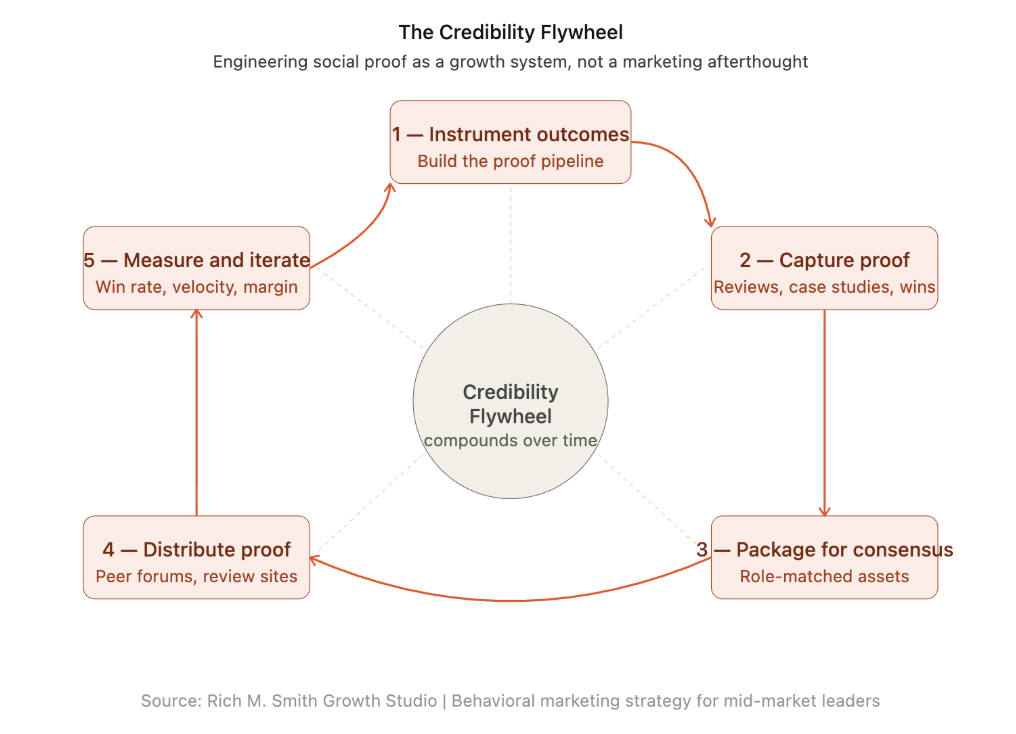
Instrument outcomes first. You cannot scale proof you can’t measure. G2 reports that 57% of buyers now expect positive ROI within three months of purchase (G2, 2024). “Eventually” is no longer a persuasive answer. Your proof must show early wins — which means your product telemetry, onboarding checkpoints, and time-to-value milestones are the raw material of your growth engine.
Capture proof deliberately. The goal isn’t a handful of case studies produced once a year. It’s a proof pipeline that reliably produces credible artifacts every month: quantified mini-cases, verified reviews, implementation narratives, role-specific outcomes. Medill Spiegel Research Center found that purchase likelihood jumps sharply once a product has even a small number of reviews — with the largest lift occurring early, not after hundreds of reviews accumulate (Spiegel Research Center, 2017). Askalidis and Malthouse confirm the pattern: steep early gains, diminishing marginal returns as volume grows (Askalidis & Malthouse, 2016). Start now. Don’t wait for a perfect library.
Package proof for consensus. Your champion is not trying to “buy.” They’re trying to help six to twelve people agree. Buying groups with six or more stakeholders were far less likely to purchase within six months than smaller groups (Challenger, 2024). Your most profitable social proof asset is often not the case study itself — it’s the consensus kit: a one-page role-specific ROI summary, a short implementation reality brief, a security evidence pack, and a decision slide your champion can paste into an internal deck. Engineered proof is a coordination tool, not just a persuasion tool.
Distribute where buyers verify. Buyers increasingly consult peer reviews and communities to narrow their shortlists (G2, 2024). Your proof must be present in the places buyers check when they don’t trust you — review platforms, peer forums, security repositories, and LinkedIn — not just your website.
Measure like a CFO. Pipeline velocity, win rate in competitive late-stage deals, gross margin retention, discount frequency — these are the metrics that connect proof to profit. Luca’s field study found that a one-star increase in public ratings was associated with a 5–9% increase in revenue for businesses studied (Luca, 2011). In B2B, credible public signals change willingness to buy and willingness to pay.
What this looks like in practice
In Slack’s S-1 filing with the U.S. Securities and Exchange Commission, the company stated that its growth was largely due to word-of-mouth recommendations — a go-to-market that capitalized on word-of-mouth adoption and customer love for the brand (Slack Technologies, Inc., 2019). The lesson for mid-market leaders is critical: the cleanest social proof strategy is building a customer experience that creates internal adoption narratives people naturally repeat — and then systematizing the capture and distribution of those narratives before a competitor does it first.
Don’t overlook the LinkedIn multiplier, either. LinkedIn reports that employees have networks approximately 10 times larger than their company’s follower base (LinkedIn, 2016). Training executives and functional leaders to publish role-relevant insights — not product pitches — turns your people into a controlled, human proof distribution system. The 2025 Edelman Trust Barometer confirms that business remains the most trusted institution measured, and employee trust in their employer remains high (Edelman, 2025). That trust is a revenue asset sitting in the wrong org chart box.
The executive bottom line
Your buyers are not failing to choose you because your product is unclear. They’re failing to choose you because the organizational cost of choosing you still feels too high.
Social proof, properly engineered, lowers that cost. It reduces perceived risk. It accelerates consensus. It protects margin by reducing the discount demands that spike when buyers feel uncertain. And it compounds — each credible signal makes the next one more believable.
This is how mid-market companies grow without endlessly adding headcount to compensate for trust deficits. Engineer the credibility. Measure it like revenue. And treat your customer evidence as the growth asset it actually is.
About Rich Smith: Rich Smith is an executive advisor, behavioral marketing strategist, investor, CMO, and host of the Revenue Science Podcast, known for helping leaders understand not only what growth strategies work—but why. With more than thirty years of experience leading growth across financial services, healthcare, technology, and consumer brands, Rich has guided companies through crises, rebuilt brands from the ground up, and helped position organizations for nine-figure exits. Connect at RichMSmith.com, on LinkedIn, and on The Revenue Science Podcast.
References
Asch, S. E. (1952). Group pressure and the modification of judgments. In H. Guetzkow (Ed.), Groups, leadership and men: Research in human relations (pp. 222–236). Carnegie Press.
Askalidis, G., & Malthouse, E. C. (2016). The value of online customer reviews. In Proceedings of the 10th ACM Conference on Recommender Systems (RecSys ’16). Association for Computing Machinery.
Challenger. (2024, February 29). How sales leaders can unlock seller performance in an uncertain economy. https://challengerinc.com/blog/how-sales-leaders-can-unlock-seller-performance-in-an-uncertain-economy/
Edelman. (2025). 2025 Edelman Trust Barometer Global Report. https://www.edelman.com/sites/g/files/aatuss191/files/2025-01/2025%20Edelman%20Trust%20Barometer_Final.pdf
G2. (2024). Buyer Behavior Report 2024. https://research.g2.com/hubfs/2024-buyer-behavior-report.pdf
Kahneman, D., & Tversky, A. (1979). Prospect theory: An analysis of decision under risk. Econometrica, 47(2), 263–291.
LinkedIn. (2016). Turning employees into brand advocates: 4 steps to an effective employee engagement program. https://business.linkedin.com/content/dam/me/business/en-us/talent-solutions/products/pdfs/turning-employees-into-brand-advocates.pdf
Luca, M. (2011). Reviews, reputation, and revenue: The case of Yelp.com (Working Paper No. 12-016). Harvard Business School. https://www.hbs.edu/ris/Publication%20Files/12-016_a7e4a5a2-03f9-490d-b093-8f951238dba2.pdf
McPherson, M., Smith-Lovin, L., & Cook, J. M. (2001). Birds of a feather: Homophily in social networks. Annual Review of Sociology, 27, 415–444.
Slack Technologies, Inc. (2019, April 26). Form S-1 registration statement. https://www.sec.gov/Archives/edgar/data/1764925/000162828019004786/slacks-1.htm
Spiegel Research Center. (2017). How online reviews influence sales. Northwestern University. https://spiegel.medill.northwestern.edu/wp-content/uploads/sites/2/2021/04/Spiegel_Online-Review_eBook_Jun2017_FINAL.pdf
Tversky, A., & Kahneman, D. (1974). Judgment under uncertainty: Heuristics and biases. Science, 185(4157), 1124–1131.