Your pipeline isn’t frozen because your product isn’t good enough.
It’s frozen because your buyers’ brains are doing exactly what evolution designed them to do when the world feels unpredictable: nothing.
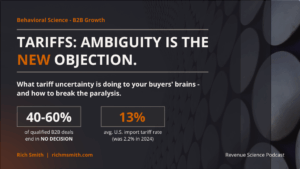
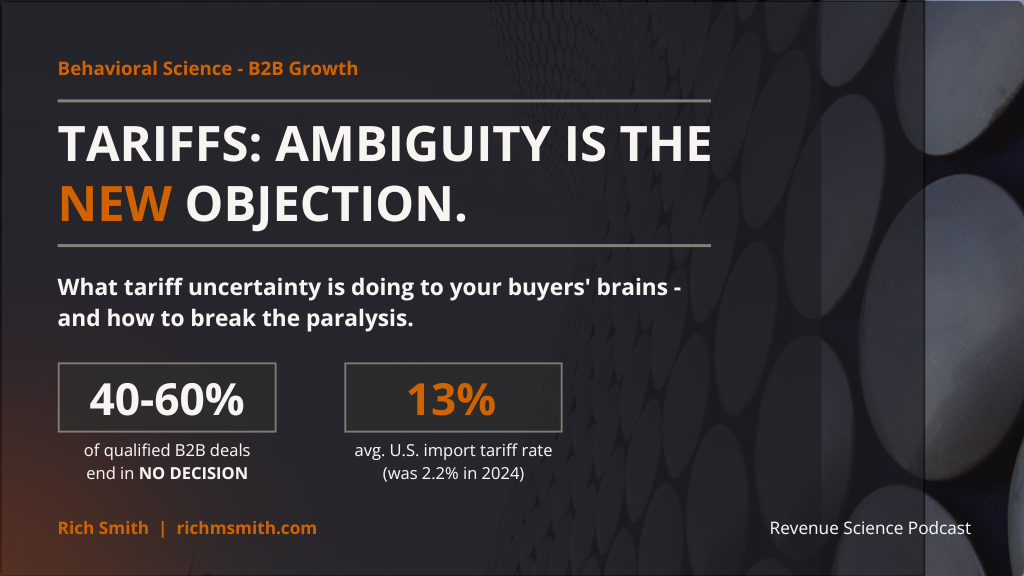
Here’s the context. April 2026 opened with U.S. import tariffs having risen from roughly 2.2% at the end of 2024 to nearly 13% today — one of the sharpest shifts in American trade policy in modern history. In February 2026, the Supreme Court struck down IEEPA-based tariffs, only for the administration to impose new ones under Section 122 within days (Harvard Law School Forum, 2026). The result: a policy environment that reshapes itself quarterly, sometimes weekly.
But here’s what almost no one in the revenue conversation is saying: it’s not the tariffs killing your deals. It’s the uncertainty.
Research increasingly confirms that the damage caused by trade policy uncertainty can exceed the direct costs of the tariffs themselves (LeMay & McMahon, 2026). A company can adapt to a known cost structure. But when the rules of trade can change with a single social media post, long-term investments stall, buying cycles lengthen, and signature pages gather dust. A San Antonio wholesale business owner summarized what I’m hearing from revenue leaders across industries: “The uncertainty is the most significant effect. People don’t want to make decisions with uncertainty” (Vistage Research Center, 2026).
That’s not a negotiating position. That’s a neurological reflex.
The Three Biases Colluding to Freeze Your Pipeline
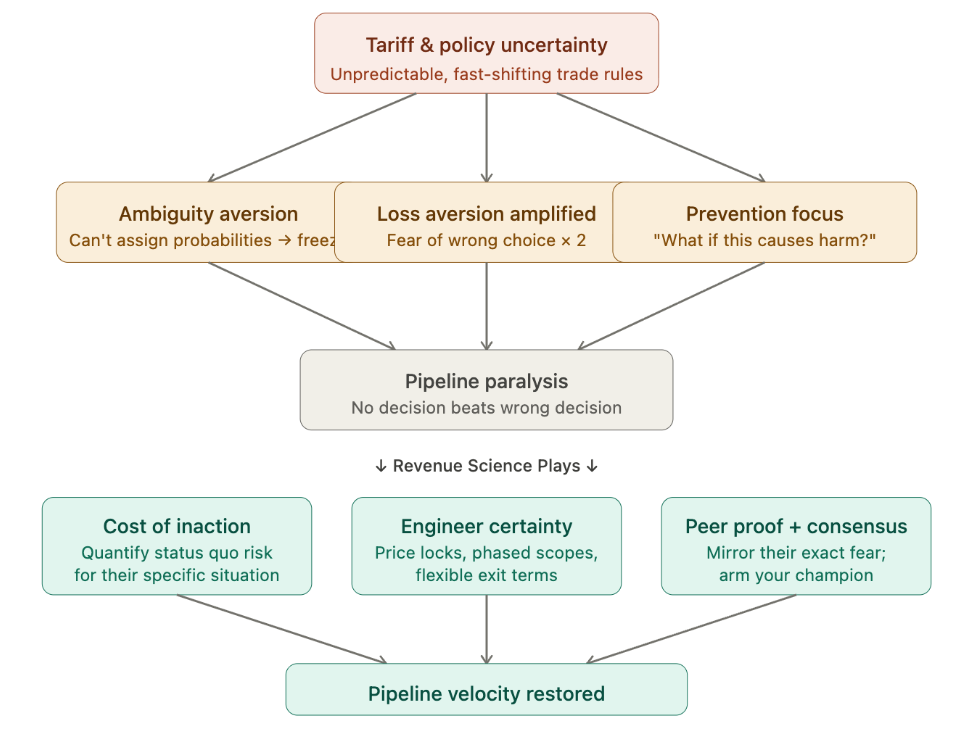
Behavioral economists have a specific name for what’s happening inside your buyers’ heads: ambiguity aversion. It’s distinct from ordinary risk aversion. Risk aversion describes discomfort with known odds. Ambiguity aversion describes what happens when outcomes are so unclear that the brain can’t even assign probabilities — triggering a reflexive default to inaction (Ellsberg, 1961; Gilboa & Marinacci, 2016). It’s not fear of a bad outcome. It’s paralysis in the face of unknowable outcomes.
Three cognitive forces are conspiring right now to lock your pipeline.
Loss aversion, amplified. Kahneman and Tversky (1979) established that losses hurt roughly twice as much as equivalent gains feel good. In a stable environment, that asymmetry is manageable. In an environment where a new tariff announcement can reshape a buyer’s cost structure overnight, loss aversion shifts into overdrive. The perceived risk of committing to your solution — and being wrong — dwarfs the appeal of getting it right.
Status quo bias, intensified. Research from the FSU Sales Institute found that during high-stress market conditions, B2B purchasing teams default overwhelmingly to incumbent vendors — not because incumbents are superior, but because change creates compounding risk (Corporate Visions, 2025). When trade policy is volatile, stability becomes a premium. Doing nothing feels like the safe choice, even when it isn’t.
Prevention focus, not promotion focus. In stable markets, buyers ask, “How do I grow? What opportunity am I missing?” Uncertainty flips them into what behavioral scientists call a prevention focus: “What could go wrong if I mess this up?” (Corporate Visions, 2025). Your ROI pitch — built for a promotion mindset — lands flat on a brain wired for defense.
The diagram below illustrates how these three forces converge from a single macro input into pipeline paralysis — and, critically, the three Revenue Science plays that reverse it.
The Data Confirms What You’re Feeling
This isn’t anecdotal. A Federal Reserve Bank of Boston study tracking small and mid-market businesses found that uncertainty about tariffs rose sharply through 2025 and correlated directly with uncertainty about investment and hiring decisions — and that a reduction in uncertainty elicited substantially more optimistic planning outlooks than any equivalent gain in certainty (Boston Fed, 2025). Baker Institute research put it plainly: even a bad trade deal is preferable to no deal, because reducing volatility — not optimizing terms — is what unlocks decision-making (Diamond, 2025).
At the pipeline level, Dixon and McKenna (2022) documented that 40-60% of B2B sales processes end in no decision at all — not with a competitor winning. In the current macro environment, that number is likely higher.
You are not losing to competitors. You are losing to the freeze.
The Revenue Science Play: Engineer Certainty When the World Won’t
The playbook shifts from feature selling to certainty engineering. Your job — in every prospect conversation — is to reduce the perceived risk of saying yes and raise the perceived risk of saying nothing.
Reframe the cost of inaction. Inaction feels psychologically safe to your buyer. Your job is to disrupt that comfort with specificity. What does “doing nothing” actually cost them — this quarter, in their specific operation, with their specific competitive exposure? Vague category-level urgency doesn’t move prevention-focused buyers. Precise, personal cost quantification does (Amplemarket, 2023).
Engineer bounded certainty into your offer structure. When the macro environment is unpredictable, structure your commercial terms to absorb the uncertainty. Price guarantees tied to specific windows. Phased scopes with clear decision gates. Flexible exit provisions that reduce the perceived irreversibility of committing. The goal isn’t to give away margin — it’s to engineer the psychological feeling of safety that allows a decision to occur.
Lead with peer proof that mirrors their exact fear. In uncertain environments, social proof is essential — but generic case studies don’t move prevention-focused buyers (MarTech, 2023). They aren’t asking “did this work for someone?” They’re asking “did this work for someone exactly like me, in exactly this situation, with exactly this type of risk exposure?” Build a reference library organized by buyer fear profile, not by industry or company size.
Help your champion build internal consensus. Research consistently shows that B2B purchase decisions involve multiple stakeholders — and under conditions of uncertainty, consensus requirements expand (Corporate Visions, 2025). Your champion is trying to move a prevention-focused committee. Equip them: the language to reframe inaction as risk, the data to quantify the cost of the status quo, and the peer examples to neutralize objections before they surface.
If you’re the incumbent, accelerate now. Research shows that under stress, buyers extend contracts longer than usual to create artificial stability (Corporate Visions, 2025). If you already have the relationship, this is not the time to coast. It is the time to deepen, lock in, and expand.
The Opportunity Inside the Freeze
Here is the counterintuitive truth: buyers under uncertainty are actually more open to engaging new vendors when they face genuinely new challenges (Corporate Visions, 2025). They’re not looking for more of what they already know. They’re looking for outside perspective, fresh insight, and frameworks that help them navigate what they’ve never navigated before.
If your positioning, messaging, and sales motion are built around being that trusted navigator — rather than being a product to evaluate — you have an asymmetric advantage over everyone in your category still pitching features.
The tariff story will keep evolving. By the time you read this, the policy may have shifted again. But the behavioral science doesn’t change. Ambiguity aversion, loss aversion, and prevention focus are not reactions to tariffs. They are deeply wired human responses to uncertainty itself.
Your pipeline isn’t waiting on a trade deal.
It’s waiting on you to engineer enough certainty that your buyers feel safe enough to act.
About Rich Smith: Rich Smith is an executive advisor, behavioral marketing strategist, investor, CMO, and host of the Revenue Science Podcast, known for helping leaders understand not only what growth strategies work—but why. With more than thirty years of experience leading growth across financial services, healthcare, technology, and consumer brands, Rich has guided companies through crises, rebuilt brands from the ground up, and helped position organizations for nine-figure exits. Connect at RichMSmith.com, on LinkedIn, and on The Revenue Science Podcast.
References
Amplemarket. (2023). Using loss aversion bias and FOMO for B2B sales success. https://www.amplemarket.com/blog/how-to-use-loss-aversion-psychology-and-fomo-to-close-more-b2b-deals
Baker Institute / Diamond, J. W. (2025, May 28). Tariffs, trade deals, and the cost of uncertainty. Rice University’s Baker Institute for Public Policy. https://doi.org/10.25613/0T8C-Z865
Boston Fed. (2025, September 5). Effects of tariff uncertainty on the outlook of small and medium-sized businesses. Federal Reserve Bank of Boston. https://www.bostonfed.org/publications/current-policy-perspectives/2025/tariff-uncertainty-on-small-and-medium-businesses
Corporate Visions. (2025, April 10). Finding stability in the storm: What B2B sales leaders must know (and do) in times of economic uncertainty. https://corporatevisions.com/blog/what-b2b-sales-leaders-must-know-and-do-in-times-of-economic-uncertainty/
Dixon, M., & McKenna, T. (2022). The JOLT effect: How high performers overcome customer indecision. Portfolio/Penguin.
Ellsberg, D. (1961). Risk, ambiguity, and the Savage axioms. The Quarterly Journal of Economics, 75(4), 643–669. https://doi.org/10.2307/1884324
Gilboa, I., & Marinacci, M. (2016). Ambiguity and the Bayesian paradigm. In D. Acemoglu, M. Arellano, & E. Dekel (Eds.), Advances in economics and econometrics (pp. 179–242). Cambridge University Press.
Harvard Law School Forum on Corporate Governance. (2026, March 16). Impact of tariffs on 2025 and 2026 incentives. https://corpgov.law.harvard.edu/2026/03/16/impact-of-tariffs-on-2025-and-2026-incentives/
Kahneman, D., & Tversky, A. (1979). Prospect theory: An analysis of decision under risk. Econometrica, 47(2), 263–291. https://doi.org/10.2307/1914185
LeMay, S., & McMahon, D. (2026). The impact of tariffs and trade policy uncertainty on SME supply chains. Journal of Small Business Strategy, 36(2), 73–86. https://doi.org/10.53703/001c.157795
MarTech. (2023, April 7). How B2B marketers can help sales overcome customer indecision. https://martech.org/how-b2b-marketers-can-help-sales-overcome-customer-indecision/
Vistage Research Center. (2026). Tariffs and economic uncertainty: A behavioral view. https://www.vistage.com/research-center/business-financials/economic-trends/tariffs-economic-uncertainty/