It is the last week of April 2026.
The Formula 1 paddock is setting up in Miami. The obvious story heading into this weekend is speed. The more important story — for CEOs, CMOs, and CROs — is structure.
Ferrari did not become one of the most profitable businesses in automotive history by maximizing unit volume. It built a system in which racing creates meaning, scarcity protects price, personalization expands margin, and client selection improves future demand quality. That is the strategic lesson worth borrowing this week: profitable growth is not just a demand problem. It is a design problem — across brand, product, channel, and commercial incentives.
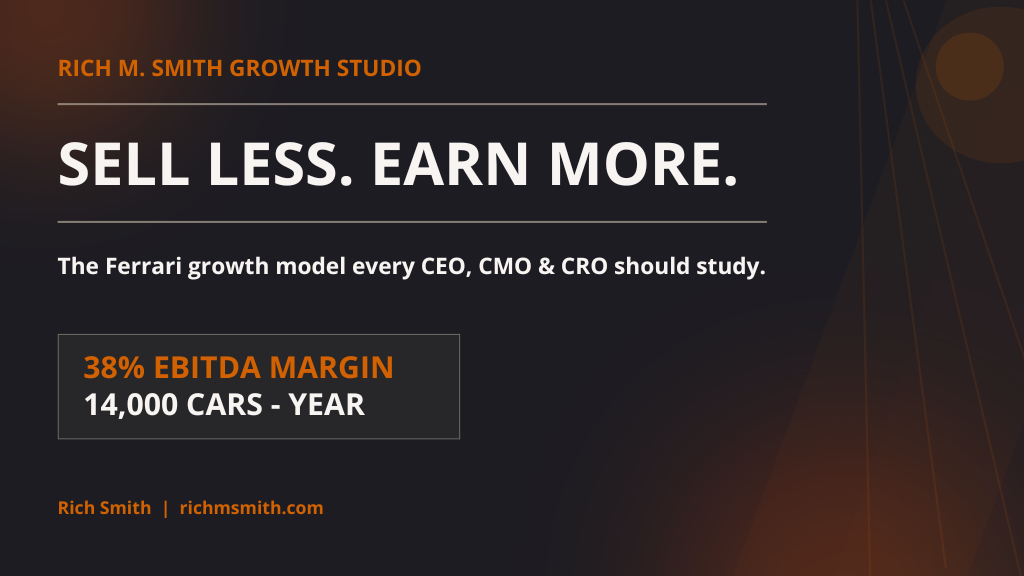
In 2025, Ferrari reported revenue above €7 billion with an EBITDA margin above 38% while limiting production to roughly 14,000 vehicles (Ferrari N.V., 2026). For context, Toyota produces over 10 million vehicles annually and operates on margins a fraction of that number.
The lesson is not “become a luxury brand.” The lesson is that the highest-earning companies are often the ones that most carefully decide who they will not serve, how much they will not sell, and where they will not compromise.
The Operating Principle Behind the Model
Enzo Ferrari’s founding philosophy was to sell “one car less than the market demands” (Ferrari N.V., 2022). Most revenue teams would call that malpractice. The market has called it a masterclass.
Ferrari’s 2022 Capital Markets Day materials documented the results: between 2018 and 2022, its client base grew by 25%, new clients were eight years younger on average, and top collectors added an average of 25% more Ferraris to their garages (Ferrari N.V., 2022). Ferrari did not choose between growth and exclusivity. It engineered growth through exclusivity — and then reported 2027 order-book visibility in its 2025 results presentation.
That is not a brand story. That is an operating system.
The Behavioral Science Behind the Numbers
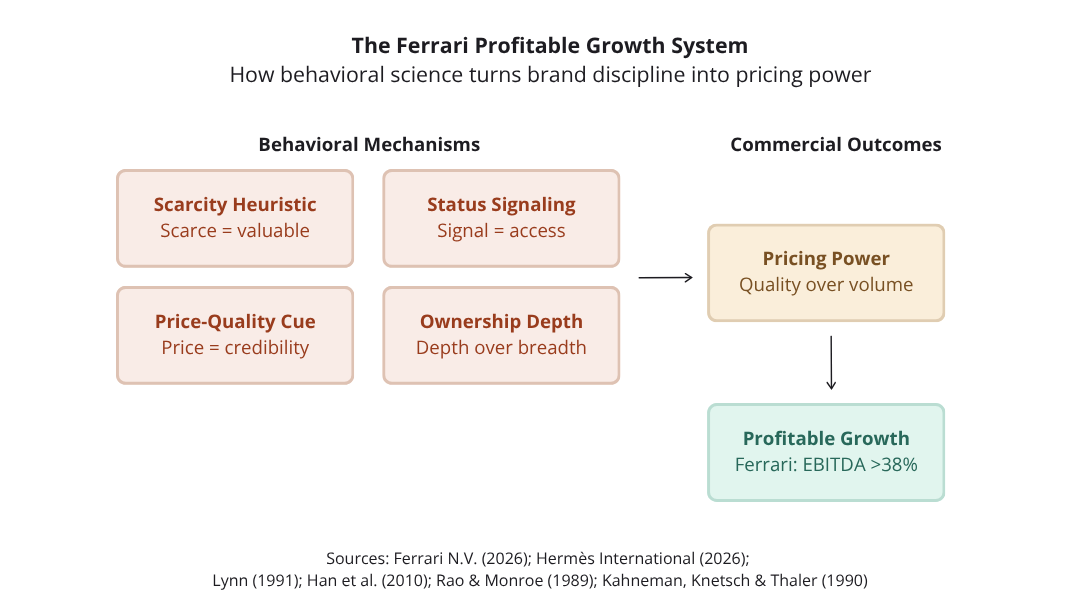
Ferrari’s commercial architecture exploits four well-documented mechanisms from behavioral science — each one worth understanding on its own, and extraordinarily powerful in combination.
The scarcity heuristic. Research has consistently shown that scarcity increases perceived value when the scarcity feels meaningful rather than manufactured (Lynn, 1991). Ferrari uses allocation limits, invite-only access, and conservative shipment policies to convert supply restraint into demand intensity. The waitlist is not a supply problem — it is a pricing and positioning asset.
Status signaling. Leibenstein (1950) documented that some goods become more desirable precisely because they are rare and expensive. Later research by Han, Nunes, and Drèze (2010) showed that affluent buyers often prefer signals that insiders recognize even when outsiders do not. Ferrari delivers both. The prancing horse is globally recognizable — but the deeper signal is quieter: model lineage, allocation access, the fact that a collector was invited to buy at all. The real badge is not the logo. It is access.
The price-quality heuristic. Rao and Monroe (1989) found that price itself communicates quality, particularly in categories where technical excellence is difficult to evaluate in advance. Ferrari does not merely charge high prices because quality is high — it also earns perception of quality because prices are high. The premium is simultaneously a margin driver and a belief signal.
Ownership attachment. Kahneman, Knetsch, and Thaler (1990) documented the endowment effect: once people possess something, they value it more. Ferrari extends this through post-purchase design — Classiche restoration services, track day programs, extended warranties up to 15 years, and owner community rituals. By the 2025 Capital Markets Day, the company reported that 100% of delivered vehicles are now uniquely personalized (Ferrari N.V., 2025). Post-purchase is not a support function. It is a margin function.
Five Lessons Your Revenue Team Can Use This Quarter
These are not luxury-brand lessons. They are revenue architecture lessons.
→ Sell a signal, not a specification. Ferrari’s buyers are not purchasing horsepower. They are purchasing identity, belonging, and continuity with a story that has been protected for 75 years. For your business: what does buying your product say about a customer’s judgment and ambition? If the answer is vague, your pricing power will be too.
→ Practice selective scarcity. Identify the products, tiers, or channels where over-availability is compressing price or diluting positioning. Ferrari caps its Icona ultra-premium models at less than 5% of total volume (Ferrari N.V., 2022). What is your equivalent? What would happen to demand — and price — if you protected it more carefully?
→ Build a halo that does real work. Ferrari’s racing program is simultaneously marketing, technology development, and global brand visibility. You do not need a race team. You need a benchmark asset — a flagship product, a category-defining event, or a respected certification ecosystem — that shapes brand meaning and pipeline quality at the same time.
→ Monetize depth before breadth. Deeper client monetization almost always carries better margins than undisciplined top-of-funnel expansion. Ferrari grows by increasing average revenue per client and lifetime relationship value faster than it grows physical volume (Ferrari N.V., 2022, 2025, 2026).
→ Align KPIs to quality of revenue, not quantity of activity. Ferrari’s management repeatedly links earnings strength to product mix and personalization — not unit volume (Ferrari N.V., 2024, 2026). If sales leadership is compensated on units and marketing on lead count, the organization will overproduce complexity and underproduce pricing power. Better metrics: realized price per deal, gross margin by customer cohort, premium mix percentage, and retention of top-value accounts.
The Hermès Parallel — and Why It Matters
Ferrari is not the only company executing this model. In 2025, Hermès reported €16.0 billion in revenue and a recurring operating margin of 41.0% (Hermès International, 2026), continuing to outperform much of the luxury sector through controlled supply and concentrated craftsmanship.
Ferrari and Hermès operate in entirely different categories. They share the same core logic: protect desirability through discipline, and grow by deepening the relationship with fewer, higher-quality clients (Kapferer & Bastien, 2009). That logic is transferable. SaaS companies, industrial firms, professional services businesses, and healthcare organizations can all align brand promise, portfolio design, channel policy, and commercial incentives so that pricing power rises faster than operating complexity.
The Question Worth Asking Before Q2 Closes
As the engines fire in Miami this weekend, here is the question worth bringing into your next executive team session:
If you applied Ferrari’s operating principle — sell one unit less than the market demands, and charge accordingly — what would you have to change about your product, your distribution, your pricing, and your KPIs?
The answer will tell you more about your growth ceiling than your current pipeline report will.
About Rich Smith: Rich Smith is an executive advisor, behavioral marketing strategist, investor, CMO, and host of the Revenue Science Podcast, known for helping leaders understand not only what growth strategies work—but why. With more than thirty years of experience leading growth across financial services, healthcare, technology, and consumer brands, Rich has guided companies through crises, rebuilt brands from the ground up, and helped position organizations for nine-figure exits. Connect at RichMSmith.com, on LinkedIn, and on The Revenue Science Podcast.
References
Ferrari N.V. (2022). Capital Markets Day 2022 press release.
Ferrari N.V. (2025). Capital Markets Day 2025 press release.
Ferrari N.V. (2026). 2025 results presentation.
Han, Y. J., Nunes, J. C., & Drèze, X. (2010). Signaling status with luxury goods: The role of brand prominence. Journal of Marketing, 74(4), 15–30.
Hermès International. (2026). 2025 full-year results.
Kahneman, D., Knetsch, J. L., & Thaler, R. H. (1990). Experimental tests of the endowment effect and the Coase theorem. Journal of Political Economy, 98(6), 1325–1348.
Kapferer, J.-N., & Bastien, V. (2009). The specificity of luxury management: Turning marketing upside down. Journal of Brand Management, 16(5–6), 311–322.
Leibenstein, H. (1950). Bandwagon, snob, and Veblen effects in the theory of consumers’ demand. The Quarterly Journal of Economics, 64(2), 183–207.
Lynn, M. (1991). Scarcity effects on value: A quantitative review of the commodity theory literature. Psychology & Marketing, 8(1), 43–57.
Rao, A. R., & Monroe, K. B. (1989). The effect of price, brand name, and store name on buyers’ perceptions of product quality: An integrative review. Journal of Marketing Research, 26(3), 351–357.
Reuters. (2024, October 17). Ferrari unveils new $3.9 million F80 supercar.