It is late March. Q1 is nearly in the books. Somewhere in your organization, someone is quietly adjusting a forecast, reclassifying pipeline, or having a very uncomfortable conversation about whether the plan is actually a plan or just a collection of optimistic assumptions held together by a good slide deck.
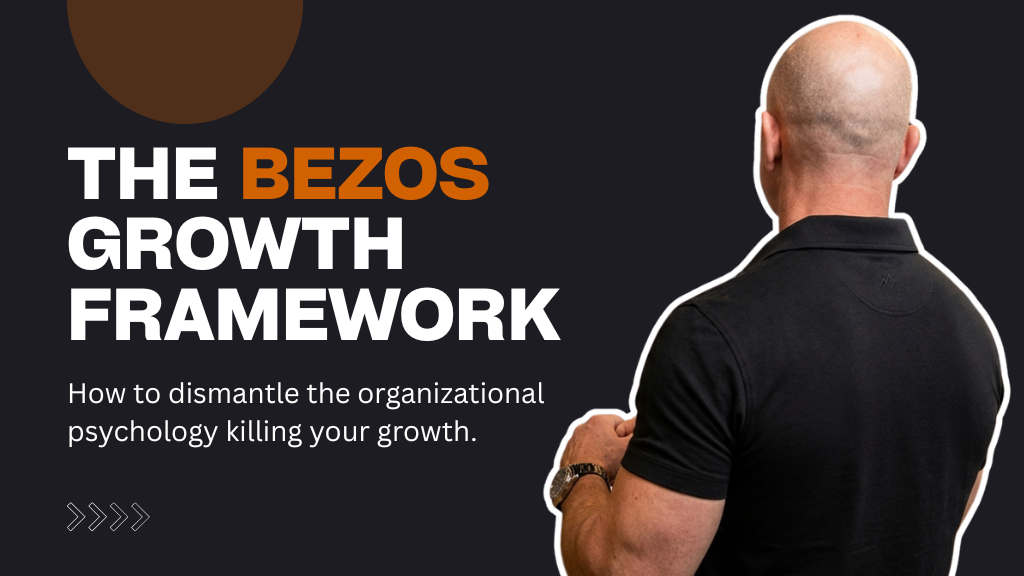
This is exactly the moment to revisit Jeff Bezos’s annual shareholder letters.
Not because they are nostalgic. Because they are operating manuals. Across more than two decades — from Amazon’s original 1997 letter to the final one Bezos authored in 2021 — a handful of principles repeat with unusual consistency. They are not slogans. They are the architecture behind one of the most improbable growth stories in business history. And they map directly onto what behavioral science tells us actually drives durable performance (March, 1991).
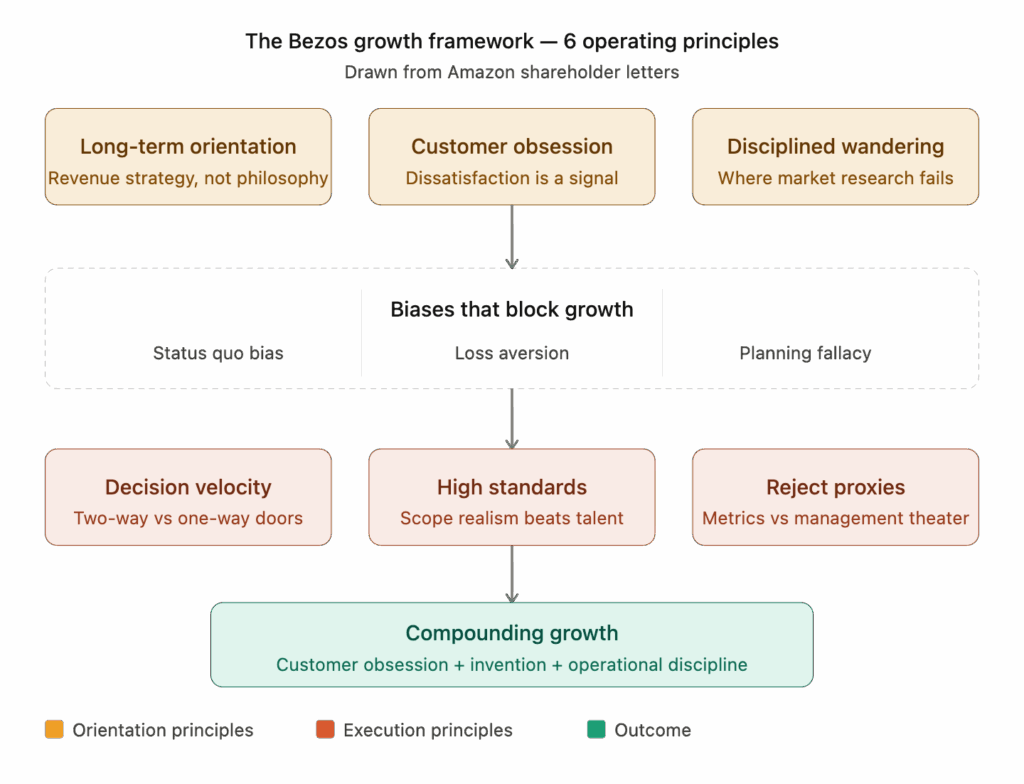
Long-term thinking is a revenue strategy, not a personality trait
In Amazon’s first letter to shareholders, Bezos framed the company’s mission as building an “enduring franchise” by creating genuine customer value in large markets (Bezos, 1998). By 2008, the logic was more explicit: long-term orientation works because it supports the failure, iteration, and invention required to solve durable customer problems (Bezos, 2009).
This matters because most organizations default to what March (1991) called exploitation — mining what they already know how to do. Exploration feels inefficient in the short run. But companies that over-index on exploitation become vulnerable exactly when their market changes. The 2020 shareholder letter documented the compounding result: more than 200 million Prime members worldwide and third-party sellers accounting for nearly 60% of retail sales (Bezos, 2021). That outcome was built over decades, not quarters.
Customer obsession is not about being nice
In the 2016 and 2017 letters, Bezos made an argument that most companies misread. Customers are never fully satisfied, he wrote. Yesterday’s “wow” becomes today’s table stakes (Bezos, 2018a). That is not an argument for endless investment with no return. It is an argument that customer dissatisfaction is a strategic signal — one most organizations are too busy protecting current margins to hear.
The Prime example is instructive. No customer asked Amazon to invent it. But Amazon observed friction in the buying experience and built infrastructure around eliminating it. Research on customer satisfaction reinforces the business logic: customer satisfaction data predict loyalty, complaint behavior, and future revenue — and decades of work link satisfaction directly to profitability, even controlling for industry conditions (Yeung & Ennew, 2000). The implication for growth leaders is powerful: the best marketers are not demand generators. They are architects of lower-friction customer behavior.
Big growth starts where market research runs out
In the 2018 letter, Bezos defended what he called “wandering” — disciplined exploration guided by curiosity and customer intuition rather than linear planning (Bezos, 2019). He argued that the outsized discoveries are unlikely to come from straight-line forecasting alone, writing directly that “market research doesn’t help” when customers lack the vocabulary to describe a genuinely new solution.
AWS is the case example. No customer asked for it. Amazon followed a hunch about what builders would need, kept iterating, and by 2020 it had reached a $50 billion annualized run rate. By 2023, AWS revenue rose 13% year-over-year to $91 billion, while Amazon’s overall operating income improved from $12.2 billion to $36.9 billion (Jassy, 2024). The lesson is not “launch a cloud division.” It is that the most valuable adjacencies often emerge from recurring customer friction observed across a core business — and someone brave enough not to wait for a survey to confirm it.
The biases quietly killing your Q2
This is where behavioral science earns its seat at the leadership table.
Most growth teams are not failing because they lack smart people. They are failing because human psychology is working against them in highly predictable ways. Status quo bias leads teams to defend current plans even when the evidence is weak (Samuelson & Zeckhauser, 1988). Loss aversion causes executives to overweight the pain of a visible short-term miss relative to the less immediate value of experimentation (Kahneman & Tversky, 1979). And the planning fallacy reliably produces optimistic timelines and underestimated scope (Kahneman, 2011).
Bezos’s letters read almost like a practical counter-program to these biases. Keep the company in “Day 1.” Resist proxies. Expect invention to be messy. Coach teams on realistic scope and standards. In other words: design the management system so that human bias does less damage.
Speed matters — but only if you know what kind of decision you’re making
In the 2016 letter, Bezos introduced the distinction between “one-way doors” and “two-way doors” (Bezos, 2018a). Irreversible decisions deserve rigor and caution. But many growth decisions — channel tests, pricing pilots, creative experiments, audience refinements — are reversible. Treating them like irreversible bets is not caution. It is lost learning velocity disguised as rigor.
Many leadership teams ask for more data, more approval layers, more perfect certainty. Meanwhile, the window for action closes. Disagree and commit, Bezos argued, beats endless consensus-seeking. That is especially valuable advice in Q2 planning season.
The bottom line
Bezos did not build Amazon by asking what would make the quarter look cleaner. He built it by asking what would make the customer relationship stronger, the learning loop faster, and the business model harder to displace.
Spring is a good time to prune. It is also a good time to plant. The companies that grow systemically — year over year, through leadership transitions and market shifts — are the ones that build an organizational philosophy that compounds. Start with the customer. Work backwards. Balance efficiency with informed exploration. Move faster on reversible decisions. Measure outcomes, not proxies. And make peace with the fact that the most valuable bets often look awkward in their earliest form.
The real barrier to growth is rarely intellect. It is organizational psychology. Bezos spent over 20 years trying to tell us that.
About Rich Smith: Rich Smith is an executive advisor, behavioral marketing strategist, investor, CMO, and host of the Revenue Science Podcast, known for helping leaders understand not only what growth strategies work—but why. With more than thirty years of experience leading growth across financial services, healthcare, technology, and consumer brands, Rich has guided companies through crises, rebuilt brands from the ground up, and helped position organizations for nine-figure exits. Connect at RichMSmith.com, on LinkedIn, and on The Revenue Science Podcast.
References
Bezos, J. (1998, March 21). Amazon’s original 1997 letter to shareholders. Amazon. https://www.aboutamazon.com/news/company-news/amazons-original-1997-letter-to-shareholders
Bezos, J. (2009). 2008 shareholder letter. Amazon Investor Relations. https://ir.aboutamazon.com/files/doc_financials/annual/Amazon_SH_Letter_2008.pdf
Bezos, J. (2018a, March 21). 2016 letter to shareholders. Amazon. https://www.aboutamazon.com/news/company-news/2016-letter-to-shareholders
Bezos, J. (2018b, April 18). 2017 letter to shareholders. Amazon. https://www.aboutamazon.com/news/company-news/2017-letter-to-shareholders
Bezos, J. (2019, April 11). 2018 letter to shareholders. Amazon. https://www.aboutamazon.com/news/company-news/2018-letter-to-shareholders
Bezos, J. (2021, April 15). 2020 letter to shareholders. Amazon. https://www.aboutamazon.com/news/company-news/2020-letter-to-shareholders
Jassy, A. (2024, April 11). 2023 shareholder letter. Amazon Investor Relations.
Kahneman, D. (2011). Thinking, fast and slow. Farrar, Straus and Giroux.
Kahneman, D., & Tversky, A. (1979). Prospect theory: An analysis of decision under risk. Econometrica, 47(2), 263–291. https://doi.org/10.2307/1914185
March, J. G. (1991). Exploration and exploitation in organizational learning. Organization Science, 2(1), 71–87.
Samuelson, W., & Zeckhauser, R. (1988). Status quo bias in decision making. Journal of Risk and Uncertainty, 1, 7–59. https://doi.org/10.1007/BF00055564
Yeung, M. C. H., & Ennew, C. T. (2000). From customer satisfaction to profitability. Journal of Strategic Marketing, 8(4), 313–326. https://doi.org/10.1080/09652540010003663