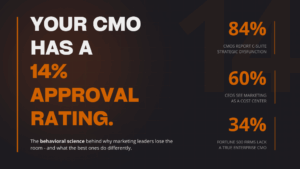
I recently revisited three books have been sitting on executive shelves for decades — Gladwell’s The Tipping Point, Godin’s Linchpin, and Cialdini’s Influence — and most business leaders have read at least one of them. The problem is they read them separately. As I read through them again, I started to see parallels and began to connect the dots between them. When read together, these three books do not give you three disconnected frameworks. They describe a single growth operating system: the right people carry a sticky message into the right context, reduce uncertainty with proof, and lower the cost of action until the buyer moves. Miss any one of those links and the chain breaks.
The problem is almost never the channel. Most companies that stall in Q2 are not short on reach. They are short on the behavioral conditions that actually cause buyers to move. More impressions will not fix weak proof. More urgency will not fix low trust. And more content will not fix an undifferentiated offer.
The real question is not “how do we get more people to see our message?” It is “how do we make the right people feel enough trust, relevance, confidence, and urgency to act?”
That shift — from distribution to behavioral architecture — is the growth lever most leadership teams have not pulled.
What the three books are really telling you
Gladwell’s The Tipping Point explains how ideas travel — through connectors, mavens, and the right social context (Gladwell, 2000). Godin’s Linchpin explains why buyers care — value-first, indispensable brands get noticed; commodity brands get skipped (Godin, 2010). Cialdini’s Influence explains why people say yes — reciprocity, social proof, authority, scarcity, consistency, liking, and unity (Cialdini, 1984).
Together they describe one chain reaction. The behavioral science is unambiguous on what drives it. Kahneman and Tversky established that under uncertainty, buyers substitute hard questions for easier ones — not “is this objectively best?” but “is this what people like me do?” (Tversky & Kahneman, 1974). That substitution is not a weakness. It is the operating system of human judgment. Designing for it is not manipulation. Ignoring it is negligence.
Five behavioral principles that compound
The diagram below maps a view of funnel stages to each of their primary behavioral drivers. Here is what that looks like in practice.
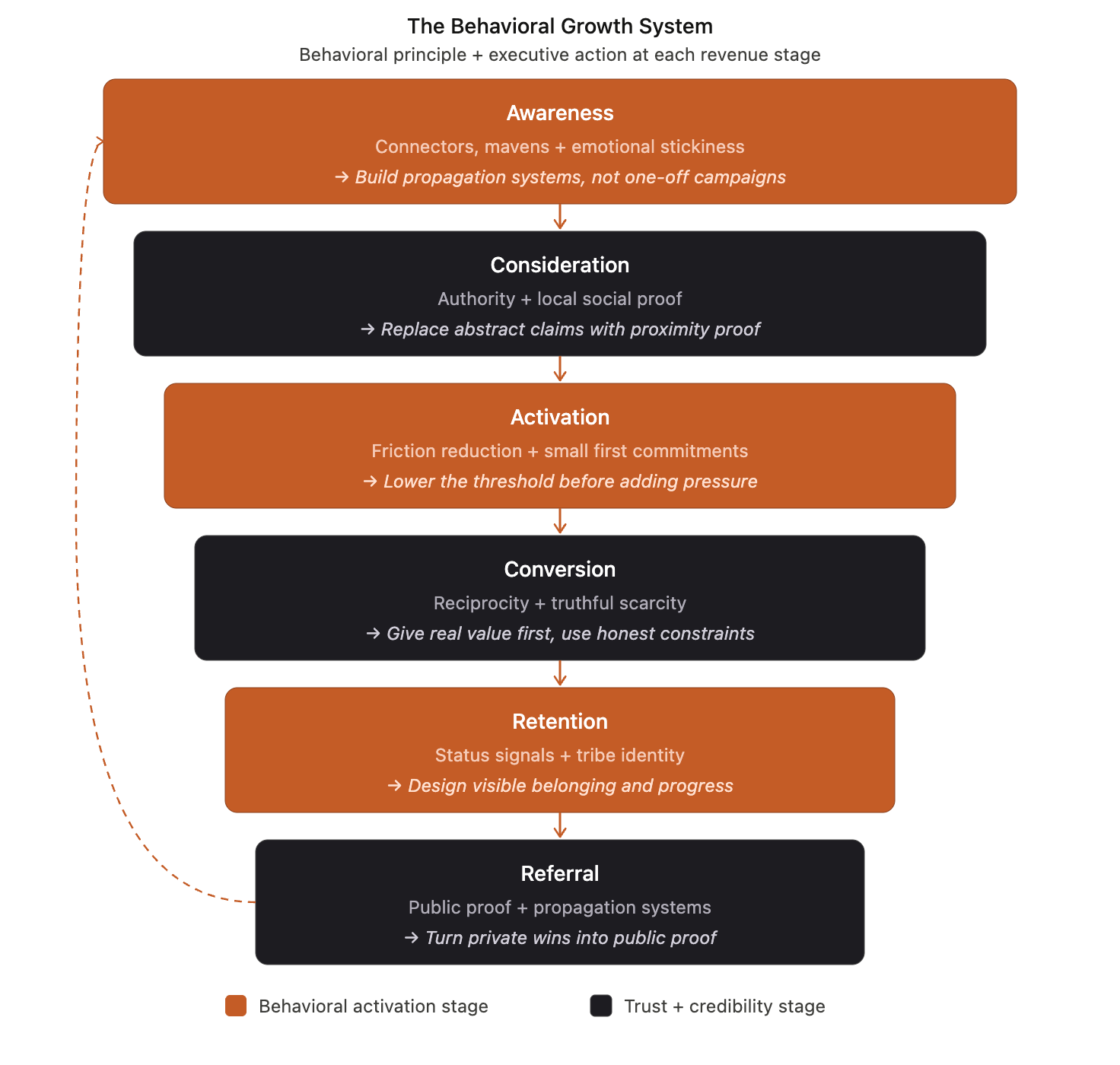
Trust travels through people, not campaigns. Gladwell’s “Law of the Few” is directionally right but incomplete. Later network research from Centola (2010) shows that behavior spreads most reliably through repeated reinforcement inside trusted clusters — peer groups, analyst communities, customer councils — not through a single charismatic carrier. The executive takeaway: build propagation systems, not influencer lists. Customer advisory boards, partner ecosystems, and vertical proof libraries compound. One-off campaigns do not.
Social proof only works when it feels local. Goldstein, Cialdini, and Griskevicius found that descriptive norms were most persuasive when they referenced behavior in the same immediate context — guests in the same hotel room, buyers with the same job title, companies with the same revenue profile (Goldstein et al., 2008). Generic proof — “10,000 companies trust us” — is weak. Proximity proof — “three companies with your headcount, in your vertical, solved this problem this way” — is strong. Replace broad credibility claims with segment-specific case studies.
Reciprocity beats empty lead capture. Godin’s concept of the “gift” and Cialdini’s reciprocity principle land in the same place: value given first creates openness to the next ask. HubSpot built Website Grader — a free diagnostic that scores a prospect’s website and provides competitive context — expressly to generate inbound demand before any sales motion began (HubSpot, n.d.). Dropbox’s dual-sided referral mechanic gave both the referrer and the new user additional storage, making the referral feel useful rather than extractive (Viral Loops, n.d.). Stop gating generic content. Give buyers something that creates a real first win.
Friction is more powerful than persuasion. Fogg’s Behavior Model holds that behavior happens when motivation, ability, and a prompt converge at the same moment (Fogg, n.d.). When buyers stall, the instinct is to add urgency. The better instinct is to ask what is broken in the ability layer. Shopify reports materially higher checkout completion from Shop Pay — a one-tap payment experience — not because the messaging improved, but because the friction disappeared (Shopify, 2023). Before adding more persuasion, remove one friction point.
Scarcity works only when it is real. False urgency destroys trust — and now it carries legal risk. The FTC’s Consumer Reviews and Testimonials Rule, effective October 2024, targets fake reviews, false testimonials, and fabricated social-influence indicators (Federal Trade Commission, 2024). Ethical constraints — limited pilot cohorts, application windows, transparent capacity limits — create the same urgency without the liability. Google’s early Gmail and Inbox launches used genuine invitation scarcity to build demand before broad release (Viral Loops, n.d.). Use truthful constraints, not pressure theater.
The order of operations matters
These principles stack. The highest-performing growth systems combine credible expertise, local proof, a small easy next step, and a reward for identity expression after conversion. Spotify Wrapped works because it makes private behavior public and identity-expressive — a shareable status artifact that turns retention into referral (Smith, 2026). Airbnb scales on visible trust: reviews, host signals, and identity verification turn uncertainty into confidence at every stage of the buyer’s journey (Airbnb, n.d.).
The sequencing rule: simplify before you intensify. Reduce friction before adding pressure. Prove relevance before adding urgency. Localize proof before spending more on reach.
Growth is not magic. It is not media buying. It is not the next channel.
It is designing the conditions under which the right people feel safe enough, confident enough, and motivated enough to act.
Gladwell tells you how adoption spreads. Godin tells you what makes a brand worth following. Cialdini tells you why people say yes.
The executive job is to turn those lessons into a system — and then run it deliberately.
About Rich Smith: Rich Smith is an executive advisor, behavioral marketing strategist, investor, CMO, and host of the Revenue Science Podcast, known for helping leaders understand not only what growth strategies work—but why. With more than thirty years of experience leading growth across financial services, healthcare, technology, and consumer brands, Rich has guided companies through crises, rebuilt brands from the ground up, and helped position organizations for nine-figure exits. Connect at RichMSmith.com, on LinkedIn, and on The Revenue Science Podcast.
References
Airbnb. (n.d.). Trust and safety at Airbnb. https://www.airbnb.com/help/article/13
Centola, D. (2010). The spread of behavior in an online social network experiment. Science, 329(5996), 1194–1197.
Cialdini, R. B. (1984). Influence: The psychology of persuasion. HarperCollins.
Federal Trade Commission. (2024). The Consumer Reviews and Testimonials Rule: Questions and answers. https://www.ftc.gov/business-guidance/resources/consumer-reviews-testimonials-rule-questions-answers
Fogg, B. J. (n.d.). Fogg Behavior Model. Stanford Behavior Design Lab. https://behaviordesign.stanford.edu/resources/fogg-behavior-model
Gladwell, M. (2000). The tipping point: How little things can make a big difference. Little, Brown and Company.
Godin, S. (2010). Linchpin: Are you indispensable? Portfolio/Penguin.
Goldstein, N. J., Cialdini, R. B., & Griskevicius, V. (2008). A room with a viewpoint: Using social norms to motivate environmental conservation in hotels. Journal of Consumer Research, 35(3), 472–482.
HubSpot. (n.d.). Website Grader. https://website.grader.com
Shopify. (2023). Shop Pay: Accelerated checkout for higher conversions. https://www.shopify.com/shop-pay
Smith, R. (2026, April 15). Social proof at scale: Engineering credibility for mid-market growth. Rich Smith’s Blog. https://richsmiths.blog/social-proof-at-scale-engineering-credibility-for-mid-market-growth/
Tversky, A., & Kahneman, D. (1974). Judgment under uncertainty: Heuristics and biases. Science, 185(4157), 1124–1131.
Viral Loops. (n.d.). How Dropbox’s referral program became a $12B growth engine. https://viral-loops.com/blog/dropbox-referral-program