It is the third week of May. Annual plans are no longer hypothetical. Q2 performance is being measured in real time. And in boardrooms across the country, leadership teams are debating the same question they debate every year at this point: How do we accelerate growth from here?
The default answer is familiar — spend more on media, drop the price, add urgency to the offer. It is also, increasingly, the wrong answer.
Last week’s post argued that growth is not a channel problem — it is a behavior design problem. That framing matters here because the tool most companies are leaving unused is not a channel at all. It is reciprocity: the human tendency, documented across decades of behavioral science, to return value after receiving it. When designed deliberately, reciprocity is not brand theater. It is a margin-preserving growth system (Cialdini, 2009; Gouldner, 1960).
The behavioral science is sharper than most executives realize
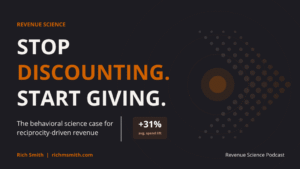
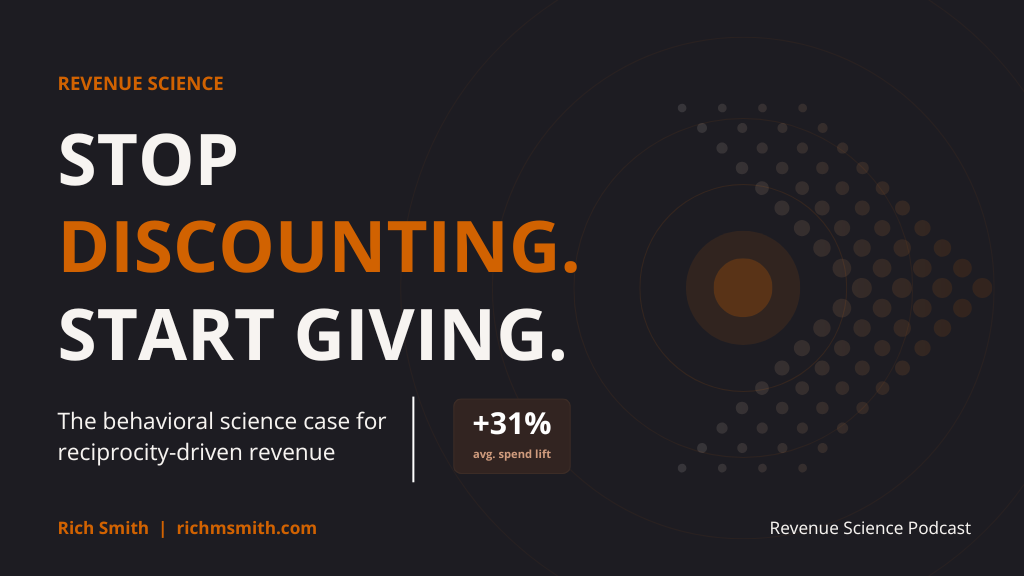
In two firm-partnered field experiments published in the Journal of the Academy of Marketing Science, customers who received an unconditional gift at store entry spent materially more than control customers — in one study, average spend rose from $32.53 to $42.83, and in another, spending rose by roughly 16% to 28% depending on whether the gift was delivered physically or by voucher (Fombelle et al., 2026).
What makes this finding executive-relevant is not the size of the effect — it is the mechanism. The research distinguishes between gratitude and obligation as separate pathways: gratitude is relational and tends to support loyalty, while obligation is transactional and tends to drive repayment-oriented spending (Fombelle et al., 2026). That distinction should shape how you design your give-to-get programs. If your “free” offer makes buyers feel managed rather than helped, you may lift a quarter and weaken the brand.
Regan (1971) showed over four decades ago that a small, unsolicited favor could increase compliance even when liking alone did not fully explain the result. Morales (2005) refined it further: consumers reward firms for visibly exerting extra effort with higher willingness to pay — not just higher conversion. In other words, when buyers infer benevolent intent, value lands differently than when they infer pure persuasion.
There is also a specific psychological phenomenon at work when price drops to zero. Shampanier, Mazar, and Ariely (2007) found that people “overreact” to zero — choosing free options at rates that standard cost-benefit models cannot predict. A free diagnostic, benchmark, trial, or tool does more than lower price friction; it changes how the offer is processed. It does not merely save money. It changes the emotional meaning of the choice.
One critical warning: Heyman and Ariely (2004) show that effort and response patterns differ when people perceive an exchange as relational rather than purely priced, and Gneezy and Rustichini (2000) demonstrated that introducing a fine in day-care centers actually increased late pickups because the moral-social frame was replaced by a market frame. A “gift” that feels like bait neutralizes the very behavior it is supposed to create.
Three companies that built revenue on generosity
HubSpot’s Website Grader was originally built to generate buzz, organic traffic, and leads — and by 2020, it had graded more than four million websites. By the end of 2025, HubSpot reported 288,706 customers and $3.13 billion in revenue (HubSpot, 2010; 2020; 2026a). The free asset was not random content. It was a product-adjacent first win tightly connected to paid expansion.
Zoom disclosed in its S-1 that 55% of the 344 customers contributing more than $100,000 in annual revenue in fiscal 2019 had started with at least one free host before subscribing — and those 344 customers contributed 30% of that year’s revenue, as the company grew from $60.8 million in fiscal 2017 to $330.5 million in fiscal 2019 (Zoom Video Communications, 2019). That is reciprocity as product design: value delivered first, adoption follows, and by the time a purchasing decision is made, the platform already feels like “ours.”
Dropbox’s referral program gave both the existing user and the new user extra storage, keeping the reward tightly linked to product value rather than cash arbitrage — and by its 2018 filing, the company had built a business with over 11 million paying users and $1.1 billion in 2017 revenue (Dropbox, 2018). The elegance is structural: the reward is native to the product, inexpensive relative to software margins, and simultaneously positive for acquisition and retention.
What this means for your growth architecture
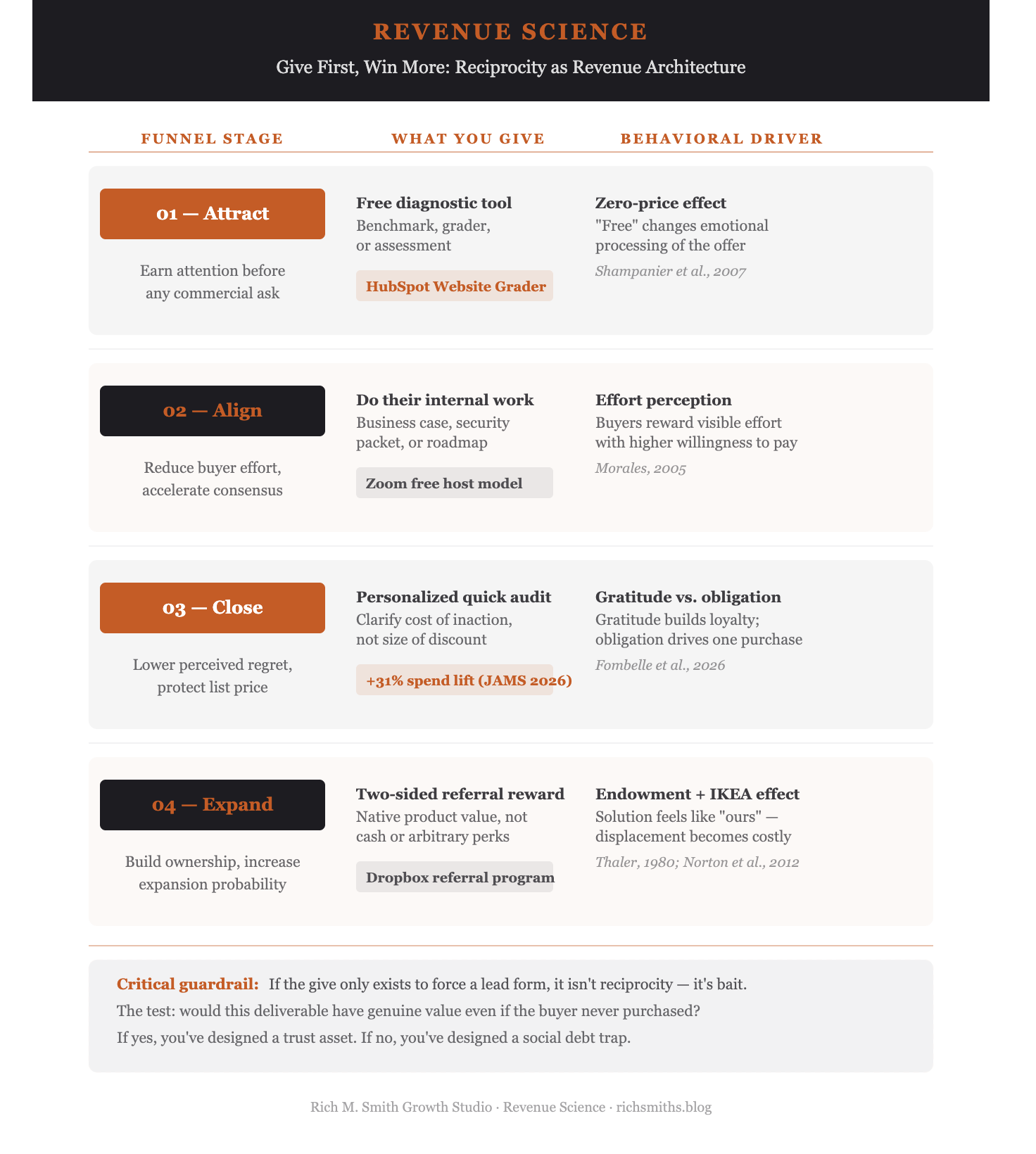
First, build a give architecture — not a generic content calendar. The research strongly favors gifts that are concrete, useful, and adjacent to the paid value proposition. A benchmark, calculator, website grader, workflow template, or industry-specific assessment does more work than a broad ungated e-book because it creates a real first win and reduces customer labor.
Second, use reciprocity at the points where decision-making friction is highest. For a CFO, that may be a finance-ready business case. For IT, a security packet. For a marketing leader, a benchmark and implementation roadmap. Reciprocity is strongest when the give resolves uncertainty the buyer already feels (Fombelle et al., 2026).
Third, protect margin by preferring value-add over price cuts. Morales (2005) found that consumers reward visible extra effort with higher willingness to pay even when product quality itself is unchanged — meaning reciprocity can support pricing power precisely because buyers often pay for the confidence that the seller has already invested in their success.
Fourth, design reciprocity as a system across the funnel: at the top, the give should attract and diagnose; in the middle, it should reduce buyer effort and accelerate internal alignment; near close, it should lower perceived regret; after purchase, it should create psychological ownership and increase expansion probability (Fombelle et al., 2026).
The executive job is to design the conditions that make buying easier
Companies that want to grow systematically should stop treating free value as a side tactic and start treating it as part of revenue architecture.
Before the prospect owes you money, they already know you were useful. That asymmetry — earned before asked for — is how trust turns into pipeline, pipeline into closed revenue, and closed revenue into margin that compounds.
Give first. Win more.
About Rich Smith: Rich Smith is an executive advisor, behavioral marketing strategist, investor, CMO, and host of the Revenue Science Podcast, known for helping leaders understand not only what growth strategies work—but why. With more than thirty years of experience leading growth across financial services, healthcare, technology, and consumer brands, Rich has guided companies through crises, rebuilt brands from the ground up, and helped position organizations for nine-figure exits. Connect at RichMSmith.com, on LinkedIn, and on The Revenue Science Podcast.
References
Cialdini, R. B. (2009). Influence: Science and practice. Pearson.
Dropbox. (2018). Form S-1 registration statement. U.S. Securities and Exchange Commission.
Fombelle, P. W., et al. (2026). The effects of unconditional gifts on customer-firm relationships. Journal of the Academy of Marketing Science.
Gneezy, U., & Rustichini, A. (2000). A fine is a price. The Journal of Legal Studies, 29(1), 1–17.
Gouldner, A. W. (1960). The norm of reciprocity: A preliminary statement. American Sociological Review, 25(2), 161–178.
Heyman, J., & Ariely, D. (2004). Effort for payment: A tale of two markets. Psychological Science, 15(11), 787–793.
HubSpot. (2010). Website Grader evaluates over 1 million URLs. HubSpot Blog.
HubSpot. (2020). HubSpot’s free Marketing Grader tool replaces Website Grader.
HubSpot. (2026a). HubSpot reports strong Q4 and full year 2025 results.
Morales, A. C. (2005). Giving firms an “E” for effort: Consumer responses to high-effort firms. Journal of Consumer Research, 31(4), 806–812.
Regan, D. T. (1971). Effects of a favor and liking on compliance. Journal of Experimental Social Psychology, 7(6), 627–639.
Shampanier, K., Mazar, N., & Ariely, D. (2007). Zero as a special price: The true value of free products. Marketing Science, 26(6), 742–757.
Smith, R. (2026, May 12). Growth is not a channel problem. It’s a behavior design problem — here’s the system. Rich Smith’s Blog. https://richsmiths.blog
Zoom Video Communications, Inc. (2019). Form S-1 registration statement. U.S. Securities and Exchange Commission.