
I’ve been having the same conversation with CEOs and founders for months now, and it always starts with the same question: “Rich, how do I know if my marketing team is ready for what’s coming?”
The answer isn’t comfortable. Most aren’t.
We’re living through a fundamental transformation in marketing leadership, and if you’re still thinking about AI as just another tool in your marketing stack, you’re already behind. The data tells a stark story: 79% of CMOs now view AI as essential for competitive advantage, with the global AI marketing market hitting $40 billion this year (Cubeo AI, 2025). But here’s what the statistics don’t capture – this isn’t just about efficiency or automation. This is about completely reimagining how we connect with customers and drive business growth.
As someone who’s spent over 25 years building profitable marketing engines across multiple industries and companies from Fortune 500 to Inc. 5000, I can tell you that the traditional CMO playbook is dead. The question isn’t whether AI will impact your marketing strategy – it’s whether you’ll lead the revolution or get left behind.
The Evolution is Already Here
Here’s a Litmus test: if your CMO is still primarily focused on campaigns with start and end dates, you have a problem. The role has fundamentally expanded, and the best marketing leaders have already made the shift.
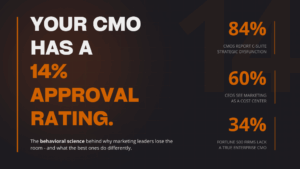
Today’s CMOs are digital transformation leaders. We’re architecting end-to-end customer experiences. We’re acting as Chief Commercial Officers, blending sales and marketing into unified growth engines. The numbers back this up – 81% of marketing leaders are now directly accountable for digital customer experience, with 84% facing increased accountability for corporate communications (IBM Institute for Business Value, 2025).
This evolution demands a new mindset. Instead of chasing individual campaign metrics, we’re building perpetual growth systems that learn, adapt, and optimize in real-time. It’s the difference between playing tactical games and architecting strategic outcomes.
The Personalization Gap That’s Costing You Revenue
Here’s a reality check that should make every CEO uncomfortable: 71% of consumers want brands to anticipate their needs with personalized offers, but only 34% of brands effectively deliver (Adobe & Econsultancy, 2025). I call this the “personalization execution gap,” and it’s where most companies are hemorrhaging potential revenue.
The companies getting this right aren’t just personalizing – they’re achieving hyper-personalization that feels almost telepathic. They’re using AI to analyze structured and unstructured data, from browsing patterns to social sentiment, creating interactions that make customers feel truly understood.
The results? Companies leveraging AI for personalization report 40% more revenue compared to their slower competitors and achieve 20% higher customer retention rates (IBM Institute for Business Value, 2025). When I work with clients to close this gap, we often see immediate impacts on both customer lifetime value and acquisition costs.
Beyond Efficiency: The Real AI Revolution
Most leaders are still thinking about AI wrong. They see Generative AI as a content production tool – and yes, it can reduce content timelines by 80% (Abraham et al., 2025). But that’s just the beginning.
The real game-changer is the shift to autonomous engagement. Agentic AI isn’t just automating tasks – it’s making decisions, taking initiative, and executing complex workflows without constant human oversight. Think virtual shopping assistants that proactively manage customer carts, or travel companions that handle entire journey orchestration from booking to arrival.
Companies are acheiving marketing productivity improvements of 5-15% of total marketing spend when they implement these systems correctly (Abraham et al., 2025). But here’s the key: it’s not about replacing humans – it’s about amplifying human creativity and strategic thinking.
The Data Problem Everyone’s Ignoring
There’s an uncomfortable truth most CEO’s and CMOs don’t want to admit: our data is a mess. Three-quarters of practitioners can’t personalize in real-time because their data lives in silos (Adobe & Econsultancy, 2025). You can have the most sophisticated AI in the world, but if your data infrastructure is fragmented, you’re building on quicksand.
The companies winning this game have made unified data platforms a strategic priority. They’ve moved beyond treating data as a byproduct and started treating it as their most valuable asset. And they’re earning consumer trust – which matters more than ever, since 88% of consumers expect responsible data handling, but only 49% of organizations meet this expectation (Adobe & Econsultancy, 2025). This isn’t just a technical problem – it’s a competitive advantage waiting to be claimed.
The Human Element That AI Can’t Replace
Here’s something that might surprise you: consumers can intuitively identify AI-generated ads, and they often find them less engaging, more annoying, and confusing (Adobe & Econsultancy, 2025). This research from NIQ should be a wake-up call for every marketing leader.
The future isn’t human versus AI – it’s human plus AI. The most successful organizations will be those that hire for heart and train for AI. We need marketing professionals who combine creative brilliance with AI fluency – the ability to understand, experiment with, and strategically apply AI tools.
Companies like Zapier are already making AI fluency a requirement for all new hires. They’re not just looking for technical skills – they’re assessing curiosity, willingness to experiment, and strategic thinking about how AI amplifies human capabilities.
The Ethics Challenge No One’s Solving
While everyone’s racing to implement AI, most are ignoring the ethical landmines. Only 22% of organizations have established clear AI guidelines for automated decision-making (Adobe & Econsultancy, 2025). This isn’t just a compliance issue – it’s a brand risk that could destroy decades of trust-building overnight.
Data privacy and algorithmic bias aren’t abstract concerns – they’re immediate business risks. AI models trained on biased historical data will perpetuate discrimination. If your AI systems aren’t continuously audited for bias and transparency, you’re playing with fire.
As marketing leaders, we’re uniquely positioned to lead AI governance. The companies that get ahead of this curve will own the ethical high ground while their competitors deal with reputation crises and regulatory backlash.
Measuring What Actually Matters
Here’s a hard truth: only 12% of organizations have working generative AI solutions with clear, demonstrable ROI (Abraham et al., 2025). Most are still stuck in pilot purgatory because they’re measuring the wrong things.
The CEO’s I see who are successfully scaling AI within their organizations focus on these metrics:
- Customer Lifetime Value enhancement: Better prediction models and retention strategies
- Customer Acquisition Cost reduction: We’re seeing 25% improvements when AI is properly deployed (Cubeo AI, 2025)
- Marketing ROI: The best implementations deliver 300% average ROI (Cubeo AI, 2025)
- Conversion rate optimization: AI-driven personalization boosts conversions by 25% or more (Cubeo AI, 2025)
- Revenue impact: Companies doing this right report 40% higher conversion rates and 35% increases in average order values (IBM Institute for Business Value, 2025)
Without rigorous measurement frameworks, you’ll never move beyond expensive experiments to scalable growth engines.
Your Action Plan: Lead or Be Left Behind
It’s so obvious that it is becoming cliche: The AI revolution isn’t coming – it’s here. The question is whether you’ll architect the future or react to it. Based on my experience, here’s what leaders need to do immediately:
First, fix your data foundation. Break down silos and invest in unified platforms. Treat data as your most strategic asset, not a byproduct of operations.
Second, invest in your people. Champion AI fluency training across your organization. Foster a culture where human creativity is amplified by AI, not replaced by it.
Third, establish ethical guardrails. Develop clear AI governance policies now, before you need them. Transparency builds trust, and trust is the foundation of sustainable customer relationships.
Fourth, redefine your CMO role. Empower your marketing leader to be a strategic architect of growth, leading digital transformation and cross-functional integration.
Fifth, demand measurable results. Implement frameworks that track real business impact, not just efficiency metrics.
The companies that will dominate the next decade are those that architect growth outcomes, build integrated data platforms, develop AI-amplified talent, and protect customer trust while personalizing experiences.
The transformation is happening with or without you. The only question is: will you lead it?
Rich Smith is a CMO, Founder, and Investor with over 25 years of experience building profitable marketing and sales engines across multiple industries, leading to 9-figure exits and billions in revenue growth. Connect with him at richsmiths.blog or follow his insights on LinkedIn.
References
Abraham, M., Apotheker, J., Edelman, D., Stringer, J., & Wiener, L. (2025, June 2). How CMOs are scaling GenAI in turbulent times. Boston Consulting Group.
Adobe, & Econsultancy. (2025). 2025 AI and digital trends report.
Cubeo AI. (2025, July 21). 25 AI marketing statistics every CMO should know in 2025.
IBM Institute for Business Value. (2025). The CMO revolution: 5 growth moves to win with AI.
Mart, A. (2025, July 21). The best AI marketing solutions for 2025. M1-Project.
Poyar, K. (2025, August 27). Your next job will require AI skills. Kyle Poyar’s Growth Unhinged.
Qiyu, J. (2025, May 28). The evolved CMO: Why AI will enhance, not replace marketing leadership. LinkedIn.
Russell, M. (2025, April 14). AI will shape the future of marketing. Harvard Division of Continuing Education.
Smith, R. (2025, August 12). CMOs in the age of AI: New mandates and responsibilities. IDC Blog.
St.Dic, T. (2025, June 5). From AI-friendly to AI-first: How Zapier is transforming hiring and onboarding. Zapier.