

As I wrote about in another article, I’ve seen countless companies and executives struggle with the fundamental question: “Why should someone buy from us?”. Often, the answers default to generic statements like “great people,” “excellent service,” or “high quality”. The challenge? Even if these are genuinely true for your company, everyone in your industry is likely saying the same or similar things. From a customer’s perspective, they cannot truly differentiate you from your competitors until they’ve become a customer and experienced your offerings firsthand. This leads to your and your competitors’ messages canceling each other out, leaving customers with no clear reason to choose you. For example, no bank says they have bad rates; they all claim to have “great rates” and “great fees,” which doesn’t differentiate them at all and makes consumers cynical about all of their advertising.
To cut through this noise and truly stand out, we must move beyond these undifferentiated claims and build a robust messaging framework: what I call your Brand House. This framework allows you to make differentiated, provable claims that resonate deeply with potential customers and motivate them to take action.
The Science Behind Decision Making: Why Your Brand House Matters
To understand how to build effective messaging, we first need to understand how people really make decisions. There’s a whole scientific field dedicated to behavioral science and decision-making that underpins this approach.
Daniel Kahneman, often called the grandfather of behavioral economics, revolutionized our understanding with his seminal book, Thinking, Fast and Slow (2011). He challenged the classical economic assumption that people act rationally, proving instead that people tend to act emotionally and then rationalize their decisions later. Kahneman introduced the concept of System 1 and System 2 thinking, which essentially represents two “brains” within us.
- System 1 (The Unconscious/Primal Brain): This part is ancient, having developed over 500 million years. It’s fast, intuitive, automatic, and always on. Its primary concern is survival, constantly monitoring for danger and seeking familiarity, as different equals danger. We have very little to no control over it. This is the source of gut feelings.
- System 2 (The Conscious/Rational Brain): This is the part we typically identify as ourselves. It’s slow, logical, deliberative, can conceptualize time (past, present, future), and seeks novelty. It’s sometimes on, sometimes off, and we have a moderate ability to control it. Engaging this rational brain actually costs us a lot of energy in the form of glucose and calories.
The critical insight here is that only about 5% of our thinking and decision-making is done consciously, while the vast majority–95%–is handled by our unconscious brain. This means that while customers might articulate what they “like, want, or need” (conscious answers), what truly motivates them are the “pain and fear” lurking below the surface—the drivers of their unconscious brain.
Furthermore, researchers have identified 188 cognitive biases and heuristics (Manoogian, 2016) that influence our decisions, largely due to this System 1/System 2 interaction. These biases and heuristics mean we tend to:
- Notice contrast (what has changed).
- Favor simplicity over complexity, as engaging our rational brain costs energy.
- Be drawn to details that confirm existing beliefs.
- Favor familiar things (different equals danger; familiar equals safe).
- Notice things primed in memory and repeated often, which is why repetition in advertising and public speaking works.
- Experience the pain of loss more acutely than the pleasure of gain. In a set of famous experiments Daniel Kahneman and his colleague Amos Tversky (1979, 1992) discovered that people’s experience of the pain of losing is about 2.3 times more emotionally impactful than the pleasure of an equivalent gain. They coined the term for this The Loss Aversion Ratio. As a result, the value of the gains we present to a customer must exceed the perceived cost of our solution by at least 2.3 times for them to feel good about the transaction.
Therefore, for effective messaging, we must understand not just what people say they want, but the underlying pain or fear that truly motivates them, and then appeal to their unconscious brain in a way that takes into account how they actually make decisions: Emotion first, rationalization second.
Constructing Your Brand House: Your Messaging Formula for Success
The formula for building powerful messaging contains three basic elements that must be brought together and it does not matter whether you are selling B2C or B2B or B2B2C. Those three elements are Customer Pain Points or Fears, Company Unique Selling Points or Claims, and Value Proof Points.
Here’s a step-by-step process to construct your Brand House:
1. Identify Target Customer Segments:
- Define your Ideal Customer Profile (ICP). For B2B companies, this goes beyond basic industry or company size and can be further segmented into subcategories within industries. It incorporates:
- Firmographics: Industry or sector, company size (employees/customers), annual revenue, geographic location.
- Technographics: Existing technology stack, software/hardware used, digital tools adopted.
- Psychographics: Values and interests, attitudes and lifestyles, motivations and behaviors.
- Challenges: Common problems or specific needs in their industry.
- Behavioral Attributes: Purchasing habits, brand loyalty, product usage patterns, engagement levels.
- For B2C companies, you will incorporate several of the same concepts but in a way that is more specific to consumers:
- Demographics: Age, income, education, household composition, marital status, occupation, etc.
- Psychographics: Values and interests, attitudes and lifestyles, motivations and behaviors.
- Challenges: Common problems or specific needs relevant to your product or service category. .
- Behavioral Attributes: Purchasing habits, brand loyalty, product usage patterns, engagement levels.
- Geographic Information: location, urbanicity, population density, ethnicity, culture.
2. Isolate Buyer Types:
- Focus on key decision-makers and significant influencers within your target segments.
- Include the most senior roles responsible for the outcome of the buying decision (B2B), as well as typical entry points into an organization (who might be searching for your solution). For B2C, include all primary decision makers.
- It’s generally not necessary to include B2B roles that only assist the purchasing process (e.g., Legal, Compliance, Info Security, Finance) in this core messaging, as they typically have little stake in the outcome or benefits of the buying decision.
- Review past sales history to identify who was involved in successful and unsuccessful deals or sales, relying on actual data as often memory and opinions can differ from reality. This helps to confirm your analysis of who is typically involved in the buying process.
3. Research Pain Points:
- This is where you play doctor and diagnose your buyers’ pains, getting beyond their stated likes, wants, and needs to the underlying pain and fear that truly motivates them.
- Consolidate these into your top three common pains across all buyer types.
- Identify the specific fear underlying each pain and give it a category label. Is it financial? Is it a personal burden? Is the fear of missing out (FOMO) or the fear of being left behind by competitors?
- If you don’t know enough about your buyers’ pain points, you may need to conduct quantitative research and/or qualitative interviews.
4. Identify Differentiated Claims:
- These are selling points that are unique to you and directly alleviate your customers’ pains.
- Your claims must be original and provable.
- Ideally, you should be able to use superlatives to describe them: “We’re the only,” “we’re the best,” “we’re the first,” “we’re the fastest,” “we’re the cheapest.”
- Get creative in how you define “the world” to make these superlatives true. For example, your “world” might be a very specific niche or geographic area, such that you could make a claim like “we’re the only company that provides <fill in the benefit of your service> to automobile dealers in the northeast United States.”
- Avoid claims that competitors also make, as these are ineffective.
5. Identify Proof Points:
- Once you have identified your unique selling points or differentiated claims, you need to provide evidence to prove them in the form of Proof Points.
- Proof points demonstrate the value of your claims, ideally through numbers and case examples, customer testimonials, or independent third party studies and awards.
- Vary the types of proof points where possible, prioritizing the strongest varieties:
- Customer Testimonials (Social category, strongest).
- Demonstrations (Experiential).
- Data, Case Studies, and Awards (Analytical).
- Company Vision of the Future (Aspirational, weakest).
- The value of your proof points must obviously exceed 2.3 times the perceived cost (not just the hard dollar costs, but all perceived costs) of your service to overcome loss aversion.
- Consider innovative ways to show proof, such as getting multiple quotes from different people within a single client organization to demonstrate deep integration.
6. Arrive at Your Overall “Why” (Meta Claim):
- This is your overarching brand statement, defining who you are and why you exist. It sometimes aligns with your company’s mission and vision, but doesn’t have to [45].
7. Make it Memorable (Appeal to the Unconscious Brain):
- Arguably the most crucial step, this is where you take all you have done and translate it to directly engage System 1. You can have perfectly identified your customer’s pains, your unique selling claims that address those pains, and proof point evidence to prove your unique selling position, but if you don’t find a way to make them memorable, they may still help your sales and revenue growth but they will not be nearly as effective.
- Find a clever and catchy way to summarize your unique selling claims.
- Fore example, rhyming is highly effective due to the “rhyme as a reason” cognitive bias (Manoogian, 2016); things that rhyme tend to be perceived as true and stick in our memory.
- Most importantly, write in the language of “YOU” and “YOUR,” not “WE” and “OUR.” Customers care about themselves, their problems and solutions to their problems and not really about your company and all the great things you do. They care about what you can do for them so write from your audience’s perspective.
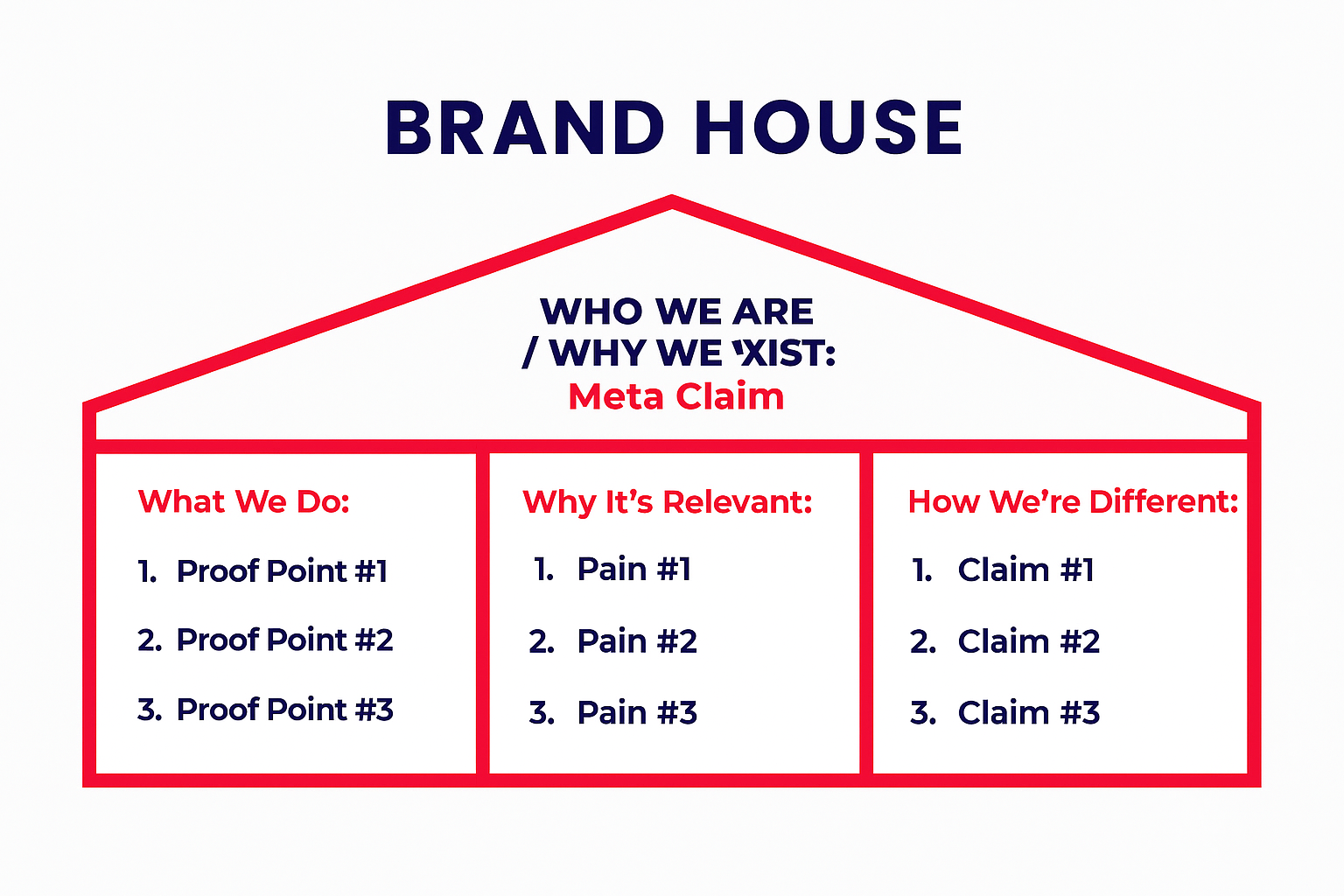
Your Brand House Structure:
Visually, your Brand House forms a cohesive framework:
- The Roof: “Who We Are / Why We Exist” (Your Meta Claim)
- Pillar 1: “What We Do” (Your roof points and evidence).
- Pillar 2: “Why It’s Relevant” (The pains your buyers experience).
- Pillar 3: “How We’re Different” (Your unique selling points or differentiated claims).
Once constructed, your Brand House becomes the driving framework for all your messaging efforts—from your website and sales decks to brochures, pitches, and trade show conversations.
Your Next Steps:
The most challenging, yet crucial, part of this exercise is often answering: “What are you the best (first, fastest, cheapest, only, etc.) in the world?” Remember, this doesn’t have to be a grand, universal claim that covers the entire globe. Get creative and define “the world” in a way that makes your unique strengths truly stand out, even if it’s a very specific niche, demographic or industry segment, or geographic location. By methodically following these steps, you can construct a powerful Brand House that clearly articulates your value, differentiates you from competitors, and resonates deeply with your target audience by appealing to their fundamental pains and fears and if you want to go deeper or need a guide through this process, reach out to me.
References:
Kahneman, D. (2011). Thinking, fast and slow. Farrar, Straus and Giroux
Manoogian III, J. (2016). The cognitive bias codex: 180+ biases. Wikimedia Commons. https://commons.wikimedia.org/wiki/File:The_Cognitive_Bias_Codex_-_180%2B_biases,_designed_by_John_Manoogian_III_(jm3).png[1]



2 thoughts on “Construct Brand Messaging That Drives Growth: Building Your Brand House”
Well done, Rich! Combining Daniel Kahneman’s research with buyers’ inherent biases in a step-by-step process to build a brand “house” creates a memorable visual with a solid analytical base.
Thanks Ceil! I’ve found that this systematic approach greatly improves an organization’s or team’s success when creating messaging as it gives you a framework to focus your positioning to the market in a way that leverages how your audience actually makes decisions.
Comments are closed.